

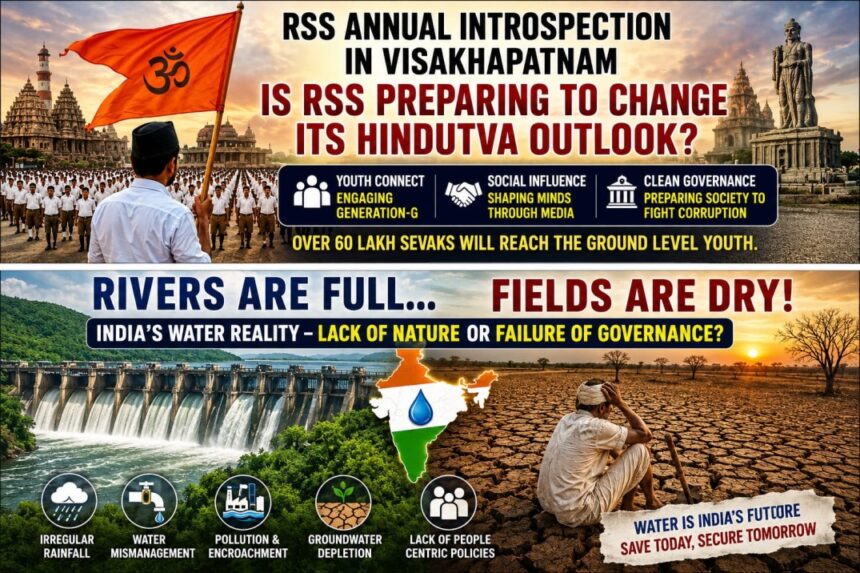
Youth dissatisfaction with the government, the power of social media, artificial intelligence and the politics of anti-corruption—does the Visakhapatnam coordination meeting signal the beginning of a new political phase?
The three-day All India Coordination Meeting of the Rashtriya Swayamsevak Sangh (RSS), held from August 19 to 21 at Gudilova near Visakhapatnam, cannot be viewed merely as another annual organisational meeting. Representatives of 32 Sangh-inspired organisations participated in the meeting, where discussions reportedly covered youth, systemic shortcomings, protests at Jantar Mantar, drug abuse, demographic changes, family values, the environment, skill development and artificial intelligence. Taken together, these subjects appear to signal an attempt by the RSS to reassess its broader social strategy for the years ahead.
The Cockroach Janata Party youth movement at Jantar Mantar provides an important political backdrop to this meeting. Beginning around concerns over shortcomings in the education system, irregularities in competitive examinations, paper leaks and uncertainty about the future of young people, the movement generated considerable discussion across the country. If a relatively small digital movement can mobilise young people through social media and create an impact on the national political discourse, no political organisation can afford to ignore the growing political power of the younger generation.
The RSS appears to have recognised this changing reality.
‘Systemic Failure’ as a Bigger Concern than Corruption
When RSS leaders were questioned about the Jantar Mantar protests, the organisation did not reduce the issue merely to corruption. Instead, it referred to shortcomings in various systems and the growing concerns among young people about their future, stressing the need for governments and society to work together to improve the system.
This is not a minor observation.
Anti-government sentiment does not emerge suddenly during elections. Experiences related to education, employment, competitive examinations, administrative transparency, corruption, prices and access to opportunities gradually determine whether young people develop trust in, or become alienated from, the government.
The Jantar Mantar movement provided a digital face to this growing dissatisfaction. It would be difficult for an organisation with the RSS’s extensive social network to ignore such a development.
Therefore, the call to correct systemic shortcomings can be interpreted not merely as an administrative suggestion but also as an attempt to understand the growing frustration among the younger generation.
From Hindutva to ‘Conversational Hindutva’?

This raises another important question: Is the RSS attempting to present its ideas of Sanatana Dharma, Hindutva and cultural identity in a new language in order to connect with younger Indians?
The RSS has not officially announced any “reconstruction of Hindutva.” However, the emphasis on engaging directly with young people rather than merely lecturing them, understanding their feelings and listening to their concerns is significant.
The organisation has stated that more than 60 percent of those attending daily Shakhas across the country are young people, while approximately 21,000 young Swayamsevaks participated in its 21-day training camps this year.
The question therefore appears to be moving beyond “How do we explain our ideology to young people?” to a more fundamental one: “What are young people thinking? What do they want? What are their fears about the future?”
That could represent an important strategic shift.
If Sanatana Dharma is presented not merely through rituals, traditions and religious identity but also through themes such as environmental responsibility, family, social service, self-reliance, technology and social responsibility, the RSS could potentially create a new connection with Generation Z.
Social Media: The New Political Battleground
The Jantar Mantar movement has demonstrated another important reality. Political influence is no longer determined only by rallies, public meetings, posters and traditional media. Increasingly, political power also depends on who controls the narrative on social media.
Generation Z is growing up in a digital environment. Satire, memes, short videos, livestreams and personal stories can influence young people more rapidly than conventional political speeches.
The RSS’s emphasis on maintaining continuous engagement with young people, along with its discussion on technology and artificial intelligence, therefore cannot be dismissed as incidental.
In the future, digital social engagement could become as important to the organisation as its traditional network of Shakhas.

The Strength of Millions of Swayamsevaks
The RSS has described its organisational reach in terms of more than 83,000 Shakhas, over six million Swayamsevaks and a large network of service activities.
Such an extensive grassroots network represents a formidable social infrastructure.
But numbers alone cannot establish a relationship with young people. Having millions of Swayamsevaks is one thing; enabling them to engage meaningfully with unemployed youth, students, small entrepreneurs, farmers’ families, women and digitally connected young Indians is quite another.
The Visakhapatnam meeting appears to place greater emphasis on the second task.
The challenge for the RSS is therefore not simply to increase the number of people attending Shakhas but to create a deeper social connection with a generation whose political behaviour is increasingly shaped by digital platforms and rapidly changing aspirations.
Why the Focus on Artificial Intelligence?
The special presentation and discussion on artificial intelligence at the RSS meeting is another significant indication of its future orientation.
The organisation discussed how artificial intelligence could be used in the Indian social context and how society could be made aware of its potential negative consequences.
This is not merely a technological discussion.
Artificial intelligence is likely to transform political communication, education, employment, media, information systems and social influence. Any social organisation that wants to retain long-term influence among young people will have to understand these changes.
The RSS appears to be attempting to enter this conversation rather than remain outside it.
Impact on BJP’s Electoral Politics?
The RSS is not a political party and does not contest elections. Nevertheless, given its ideological and organisational relationship with the Bharatiya Janata Party, its social activities inevitably have implications for electoral politics.
The Visakhapatnam meeting can therefore be viewed as an indicator of the issues that may become important for the BJP’s future political strategy. However, it would be inaccurate to describe the meeting itself as a direct electoral strategy meeting. Officially, it was a platform for coordination among 32 organisations, sharing experiences and discussing future social activities.
The political reality, however, is more complicated.
Before opposition parties can successfully convert youth dissatisfaction into electoral support, the BJP also needs to understand that dissatisfaction, strengthen its engagement with young people and respond to questions about governance.
That is where the RSS’s grassroots role becomes significant.

Is It a Game Changer?
It may be premature to declare the Visakhapatnam meeting an immediate “game changer.” But it can certainly be viewed as a significant warning about the changes that the RSS–BJP ecosystem may need to make in its future political and social strategy.
The Jantar Mantar youth movement demonstrated one important fact: the new generation is not necessarily politically passive. It can mobilise rapidly through social media. It can question governments. It can challenge established political narratives and create its own.
The RSS appears to have taken note of this changing environment.
Therefore, the organisation’s real test in the coming years may not simply be how effectively it explains Hindutva to young people. The more important question is whether it can demonstrate how its interpretation of Hindutva and Sanatana Dharma can respond to the real problems confronting India’s youth.
Employment, education, corruption, technological transformation, environmental protection, social harmony and family values are not abstract ideological questions. They are everyday concerns for millions of young Indians.
If the RSS can connect its ideological framework with practical solutions to these challenges, it could strengthen its social influence among the next generation.
If it cannot, ideological messaging alone may not be enough to attract a generation increasingly accustomed to questioning authority and seeking its own sources of information.
The Visakhapatnam coordination meeting, therefore, should not be viewed simply as another annual RSS gathering. It represents an important chapter in the organisation’s search for an answer to a crucial post-centenary question: “How should we connect with a rapidly changing Indian society?”
The youth dissatisfaction visible at Jantar Mantar may be the warning.
The Visakhapatnam meeting could be the RSS’s strategic response.
How successful that response will be may ultimately be determined not merely by future election results, but by whether India’s younger generation accepts, questions or rejects the new social and political narrative being developed around it.