Ch. V. Prabhakar Rao, 9391533339
How Long Can a Government Frighten a Generation That Asks Questions?
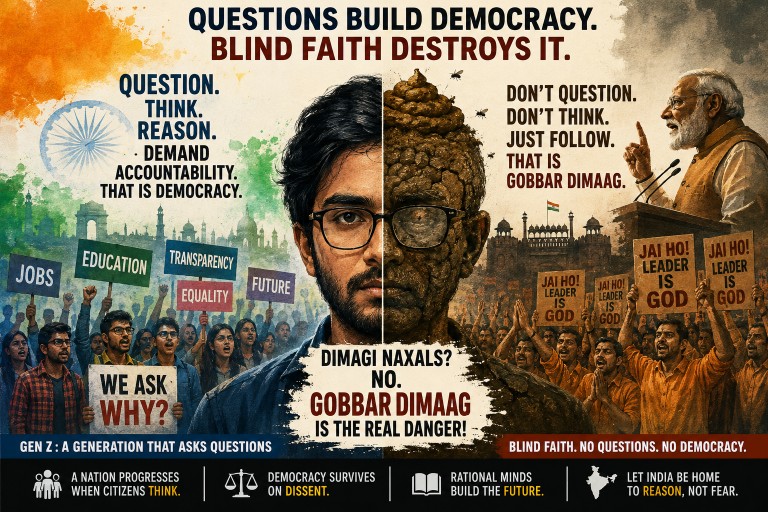
In his address on the 80th Independence Day, Prime Minister Narendra Modi chose to use a striking phrase—“Dimagi Naxals.” At a national moment meant to celebrate freedom, democracy and the aspirations of future generations, branding young people who question authority is deeply revealing. One thing, however, deserves to be said plainly: India is not endangered by minds that ask questions. It is endangered far more by minds that surrender reason and blindly applaud power—in other words, by what one might sarcastically call “Gobbar Minds.”
For a few minutes of the speech, the Prime Minister focused on what he described as ideological threats. For more than an hour, however, he spoke about India’s development, achievements and future ambitions—technology, infrastructure, economic growth, national strength and India’s expanding global stature. All of this sounds impressive. Yet one fundamental question remains: development for whom?
Is this development primarily enriching large corporations, or is it reaching the ordinary citizen? A rising GDP is one thing; a young person finding a dignified job is another. Building world-class highways is one thing; ensuring quality education for a poor child is another. Attracting massive investments is one thing; ensuring a fair income for a farmer is another. If economic statistics reach the sky while the everyday life of the common citizen remains stuck on the ground, people have every right to ask: Whose development are we talking about?

That is where the real democratic question begins.
In a democracy, there is no king. The people are sovereign. A political leader is not a ruler by divine entitlement; he is a temporary trustee of public power. Accountability, transparency, the right to dissent and the freedom to question authority are not inconveniences—they are the very foundations of democracy.
Yet for political traditions that continue to carry the psychological baggage of an age when kings were considered divinely ordained, these principles can appear uncomfortable. Modern democratic leadership cannot demand the reverence once reserved for monarchs. Power must answer questions; it cannot simply issue commandments.

Over the past twelve years, India’s political discourse has increasingly witnessed the use of religious identity, Hindu-Muslim divisions and emotional polarisation as instruments of electoral politics. Dividing society into competing camps and cultivating fear within those camps may produce electoral advantages. But believing that every generation will forever respond to the same political vocabulary is to misunderstand history.
The Gen Z generation is now putting a question mark against that old political grammar.
This is not necessarily a generation belonging to one particular political party. It is a generation that asks questions. It wants jobs. It wants quality education. It wants transparency. It wants to know what is actually happening beyond carefully managed political narratives. It is less interested in worshipping political personalities and more interested in measuring their performance.
That is the beginning of a new political consciousness.
The emergence of slogans such as “Cockroach Janata Party”—however crude or provocative they may sound—can also be understood as political satire born out of frustration. The words themselves matter less than the sentiment behind them. When citizens refuse to treat political leaders as untouchable icons and instead begin questioning their performance, every government faces a democratic test.
Governments will always have people who applaud them. But those who question governments are far more valuable to democracy.

History repeatedly demonstrates that generational change can shake established systems. From the European Renaissance to India’s anti-corruption movement, societies have periodically witnessed younger generations challenging entrenched institutions and established modes of thinking.
That does not mean every movement is automatically pure or every protest is free from manipulation. History also shows that political, economic and ideological groups sometimes attempt to appropriate popular movements for their own interests.
There are also allegations that certain movements in India have been influenced or supported by elements associated with the American “Deep State.” Such claims, however, must be treated cautiously. Without credible evidence, allegations cannot be presented as established facts. Similarly, the fact that political activists from different countries have attended training programmes conducted by international organisations does not, by itself, prove that a particular movement is a foreign-sponsored conspiracy.
Democracy permits suspicion. But suspicion is not evidence.
Political forces that draw inspiration from traditional social doctrines, including interpretations of Manusmriti, must also explain clearly how those ideas coexist with the constitutional values of modern India.
The Constitution does not see a citizen primarily through caste, religion or gender. It recognises citizens as equal holders of rights. Scientific temper, rational thinking and the freedom to question are not signs of disloyalty. They are essential ingredients of a modern republic.
There is also a striking contradiction in selectively embracing modernity.
Using smartphones, artificial intelligence, satellites and advanced technologies while discouraging scientific temper and independent reasoning is not genuine modernisation. One cannot enthusiastically embrace artificial intelligence while treating human intelligence as a threat.
One cannot celebrate technological progress and simultaneously fear a citizen who asks, “Why?”
Ultimately, ordinary Indians do not live on slogans. They need basic necessities, dignified employment, quality education for their children, security for the elderly, fair returns for farmers and a credible future for the young.
A government that cannot adequately address these fundamental needs may deliver the grandest nationalist speeches imaginable, but the value of those speeches will remain limited in the everyday lives of its citizens.
How long can a ruler govern people through fear?
History has already provided the answer: public patience has a limit.
It is easy to label questioning minds as “Dimagi Naxals.” It is much harder to answer their questions.
But questions cannot be permanently silenced.
Once a question is born, it has no prison.
A “Gobbar Mind” may applaud power without asking why.
A free mind will ask the one question that every democracy desperately needs:
“Why?”
And that single word may be the most vital breath of oxygen in a democracy.