

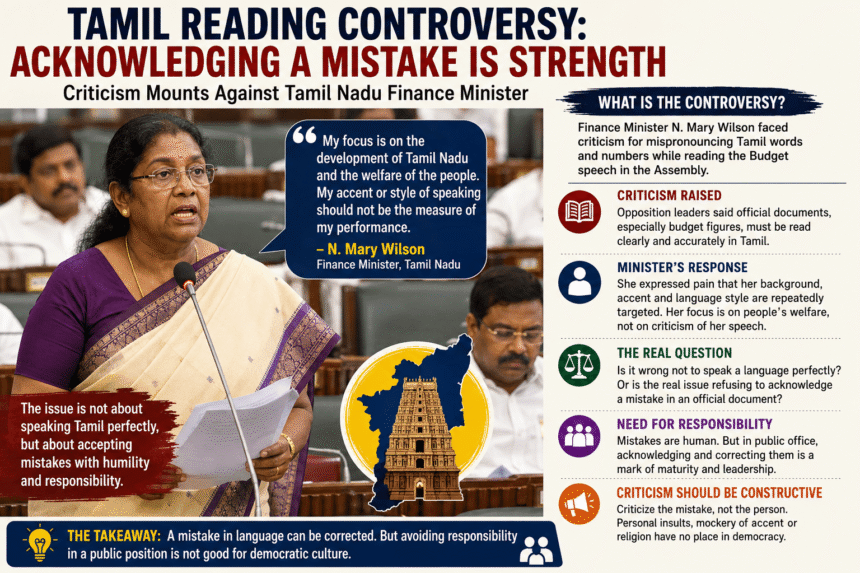
Tamil Reading Controversy: — Criticism Mounts Against Tamil Nadu Finance Minister
By Bharathi Kumar Balayya
Chennai, August 12:
A controversy has erupted over the manner in which Tamil Nadu Finance Minister N. Mary Wilson read her Budget speech in the Tamil Nadu Legislative Assembly. Criticism has intensified after she was accused of mispronouncing several Tamil words and numbers while reading the Budget documents, turning the issue into a political controversy.
Critics from the opposition pointed out that official Budget documents should be read clearly and with proper pronunciation, particularly in the Legislative Assembly, where every word and figure carries administrative significance.
Responding to the criticism, the Minister reportedly expressed anguish that her speaking style, personal background and language style were repeatedly being targeted. She maintained that her focus was on the development of Tamil Nadu and the welfare of its people, and that her accent or manner of speaking should not be used as a measure of her administrative performance.

This is where the real controversy begins. Is it wrong for someone not to speak a language fluently? Or is the real problem the refusal to acknowledge a mistake when an official document has been read incorrectly? That has become the central question in the debate.
Not knowing Tamil completely, or struggling with its pronunciation, is not necessarily something for which a person should be ridiculed. Tamil Nadu itself has numerous regional accents and variations in pronunciation. Mistakes are natural when someone is learning or using a language in which they are not fully fluent.
However, when Budget figures, numbers, government schemes and financial details are being read from an official document in the Legislative Assembly, a high degree of accuracy is essential. Every number and every word in such a document has administrative significance.

In this context, critics argue that instead of reacting angrily to those who pointed out the mistake, a more mature political response would have been to simply say, “There was a mistake while reading it. I will be more careful in the future.”
At the same time, questions must also be raised about the manner in which the criticism is being made. It is legitimate to point out that a public representative has mispronounced words or figures. But personal insults, mocking someone’s accent, or dragging their religion and personal background into the controversy cannot be justified.
The Minister’s reference to the values of love and compassion that she says she learned from Christianity reportedly led to another controversy. BJP leaders and others criticised the remarks, alleging that they amounted to belittling the Tamil language, and demanded an apology.
However, viewing the controversy simply as a confrontation between “Tamil language versus an individual” would be an overly narrow interpretation. The larger issue is about accountability in public life, the culture of accepting criticism, and the willingness to acknowledge and correct mistakes.
People do not expect those holding public office to be completely free of mistakes. But they do expect them to acknowledge mistakes when they occur and take steps to correct them. At the same time, critics must also distinguish between criticising a mistake and humiliating an individual.
Making a mistake is human; acknowledging it and correcting it is a mark of leadership.
More Read

Tamil is not merely a language in Tamil Nadu; it is deeply intertwined with the state’s cultural, political and social identity. It is therefore natural that remarks concerning the Tamil language evoke strong emotions. But just as personal abuse in the name of defending the language is unacceptable, dismissing legitimate criticism concerning the use of the language as arrogance is equally problematic.
Ultimately, the controversy carries an important message: A mistake in language can be corrected. But avoiding responsibility while holding public office is not healthy for democratic culture.