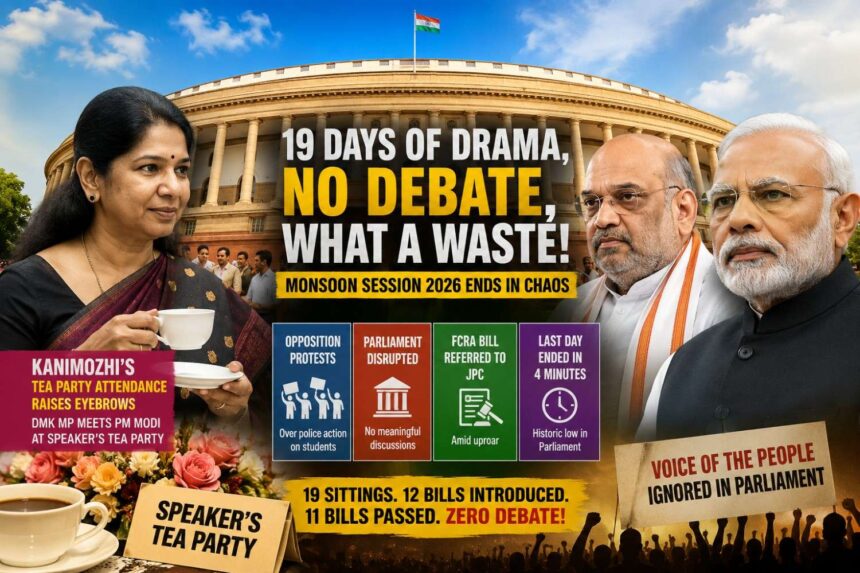
What Does Kanimozhi’s Presence at the Speaker’s Tea Party Signal? — An Editorial Analysis of the Growing Divide Between the Government and Opposition
New Delhi, August 13:
The 2026 Monsoon Session of Parliament concluded on Thursday after 19 sittings. The session, which began on July 20, will be remembered less for substantive legislative debate and more for political confrontation, protests, slogans and repeated disruptions.
The final day was no different. Amid continued opposition protests, the Lok Sabha was adjourned within minutes. Prime Minister Narendra Modi and Union Home Minister Amit Shah were present in Parliament and remained until the singing of Vande Mataram, adding a symbolic note to the conclusion of a highly turbulent session.

Against this backdrop, Lok Sabha Speaker Om Birla’s traditional tea party became an unexpected political talking point. While several INDIA bloc parties, including the Congress, Samajwadi Party and Trinamool Congress, stayed away from the event, DMK MP Kanimozhi attended it. Her interaction with Prime Minister Modi attracted considerable attention and prompted speculation about the equations within the opposition alliance.
However, interpreting Kanimozhi’s presence immediately as a sign of a political split between the DMK and Congress would be premature. In a parliamentary democracy, members of the ruling party and opposition regularly interact at official and informal events. Yet, in the present political environment, every such interaction acquires a political meaning.
The episode raises a larger question: Are differences within the INDIA bloc becoming more pronounced, and can regional parties reconcile their state-level political interests with a common national opposition strategy?

Why Did Parliament Remain Deadlocked?
The Monsoon Session began on July 20 amid protests over police action against students and young protesters. Opposition parties demanded a discussion on the alleged use of force, including lathi-charge and other measures, and sought accountability from the government.
The Congress and other opposition parties subsequently pressed for discussions on the issue inside Parliament. They also raised broader concerns relating to students, examination systems and alleged irregularities. The government, meanwhile, maintained that it was willing to discuss issues but accused the opposition of preventing Parliament from functioning normally.
The result was a prolonged confrontation.
This is where the fundamental question concerning parliamentary democracy arises. The opposition has every right to protest, but Parliament also has the responsibility to function. The government must provide adequate opportunities for discussion, while the opposition must ensure that protest does not become a permanent substitute for debate.
Parliament is not merely a place for passing legislation. It is the principal forum for questioning the government, raising public grievances, examining policies and demanding ministerial accountability.

When Parliament is repeatedly disrupted, the entire democratic process suffers.
FCRA Bill: An Important Development Amid the Chaos
Despite the disruptions, the government succeeded in advancing several legislative measures. One of the most significant developments was the decision to refer the Foreign Contribution Regulation Act (FCRA) amendment legislation to a Joint Parliamentary Committee.
The decision to send the legislation to a JPC is significant because it provides an opportunity for detailed examination and consultation rather than rushing the measure through Parliament amid political confrontation.
This also demonstrates why parliamentary functioning matters. Even controversial legislation can benefit from committee scrutiny, expert testimony and examination of the concerns raised by opposition parties and stakeholders.
Therefore, it would not be entirely accurate to describe the entire 19-day session as one in which “nothing happened.” Bills were introduced and some were passed. Legislative business did take place.
But the larger concern remains the quality and quantity of parliamentary debate.
Passing legislation is only one part of parliamentary democracy. The manner in which laws are examined, questioned and debated is equally important.
A Four-Minute Finale: A Warning for Democracy
The extremely brief proceedings on the final day became a symbolic conclusion to the session.
The government can legitimately argue that legislative business was completed despite disruptions. The opposition can equally argue that it was denied adequate opportunities to raise issues of public importance.
Between these two positions lies the real casualty: the culture of parliamentary debate.
A functioning Parliament requires both sides.
The ruling party must be accountable to Parliament. The opposition must be able to question and challenge the government. At the same time, the opposition cannot allow continuous disruption to become its primary parliamentary strategy.
If Parliament becomes a venue only for protests and adjournments, important public issues may never receive the detailed discussion they deserve.
Kanimozhi’s Tea Party Attendance: A Signal of Dialogue?
It is in this context that Kanimozhi’s presence at the Speaker’s tea party becomes politically interesting.
Her attendance does not necessarily indicate a break within the INDIA bloc. Nor does her interaction with Prime Minister Modi automatically imply a change in the DMK’s political position.
But it does underline one important reality: all opposition parties may not always adopt identical strategies.
The political interests of Tamil Nadu, the DMK’s relationship with the Congress, Centre-State issues and the party’s broader national strategy can all influence its parliamentary decisions.
The larger lesson is that democracy ultimately depends on dialogue.
Government and opposition may disagree sharply on policy. They may fight elections against one another. They may stage protests and walkouts. But parliamentary democracy cannot function indefinitely without communication between political rivals.
A tea party may appear insignificant in comparison with major political battles. Yet informal conversations can sometimes create channels of communication that formal parliamentary confrontation closes.
Who Lost in the 19-Day Standoff?
The most important question emerging from this session is not simply how many bills were introduced or passed.
It is:
How many hours were spent discussing people’s problems? How effectively was the government questioned? How much opportunity did MPs receive to scrutinise legislation? And how effectively did the opposition convert its protests into parliamentary debate?
These questions will ultimately determine the historical significance of the 2026 Monsoon Session.
The government and opposition must both learn from the experience.
For the government, the lesson is that parliamentary majority does not eliminate the need for consultation and accountability. For the opposition, the lesson is that protest is an important democratic weapon, but it cannot permanently replace debate.
A Parliament that does not function is not a victory for either side. It is a loss for the people who elected it.
The 19-day Monsoon Session has therefore left behind a larger democratic challenge. The ruling establishment must create space for meaningful opposition scrutiny, while the opposition must ensure that its strategy does not paralyse the very institution through which it represents the people.
Kanimozhi’s participation in the Speaker’s tea party may eventually prove to be just a routine parliamentary gesture. Or it may become a small indication that, beneath the surface of political confrontation, some parties still recognise the importance of dialogue.
Either way, the central message of this session is unmistakable:
Parliament needs debate, not merely disruption; accountability, not merely confrontation; and dialogue, not permanent deadlock.