

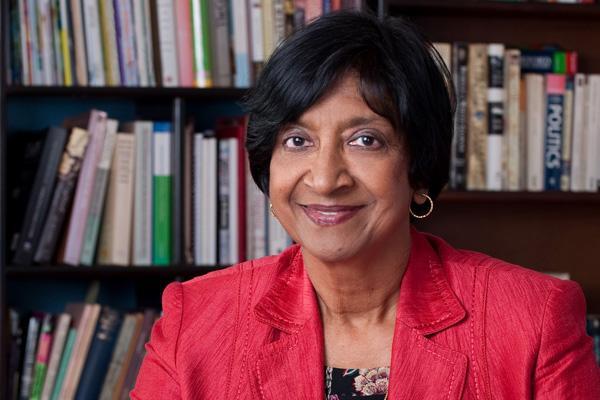
Editorial | International Politics and Human Rights
The recognition of Navanethem “Navi” Pillay, a distinguished South African jurist of Indian Tamil origin, has brought renewed attention to the relationship between international justice, human rights and global power politics. Her decades of work as a lawyer, judge and international human rights advocate have made her an influential figure in the struggle against racial discrimination, genocide and crimes against humanity.
However, the reported controversy surrounding her recognition, the criticism from US President Donald Trump and the Israeli leadership, and the limited visibility of reactions from India’s national political leadership raise important questions. Why should the recognition of a human rights advocate become a political controversy? And why does India appear hesitant to celebrate a woman whose ancestral roots connect her to the country?
From Indian Roots to International Justice
Born in Durban, South Africa, in 1941, Navi Pillay grew up during the apartheid era, when racial discrimination was institutionalised. Coming from a family of Indian Tamil origin, she experienced the consequences of a deeply unequal society. She chose law as a means of challenging injustice and defending fundamental rights.
In 1995, Pillay became the first Black woman appointed to South Africa’s High Court. She subsequently served as a judge and president of the International Criminal Tribunal for Rwanda, which prosecuted those responsible for the 1994 genocide. The tribunal’s jurisprudence helped establish important legal principles concerning sexual violence as an instrument of genocide.
She also served as a judge at the International Criminal Court and, from 2008 to 2014, as the United Nations High Commissioner for Human Rights. Throughout her career, she advocated accountability for serious human rights violations, regardless of the political or military power of those accused.

Her work demonstrates that international law must protect victims and hold perpetrators accountable, rather than become an instrument available only to powerful countries.
Why Are Trump and Israel Critical?
The controversy surrounding Pillay reflects a broader conflict between international human rights institutions and governments that believe such institutions can undermine their national interests.
Pillay’s association with investigations into alleged violations in the occupied Palestinian territories has drawn criticism from Israel. The findings of UN investigative bodies concerning Israel’s conduct in Gaza have been strongly disputed by the Israeli government. These allegations and findings must be distinguished from final judicial determinations, and every claim must be assessed through evidence and due process.

The Trump administration has also taken a confrontational position towards international institutions, particularly the International Criminal Court, over investigations and legal proceedings that it considers contrary to American interests.
The underlying question is fundamental: Should powerful countries and their leaders be exempt from international scrutiny? If human rights investigations become unacceptable whenever they concern influential governments, the principle of equal accountability loses its meaning.
Criticism of a government is not necessarily hostility towards its people or country. Equally, international institutions must maintain impartiality, apply consistent legal standards and substantiate their conclusions with credible evidence.
India’s Silence: Diplomacy or Political Hesitation?
Pillay’s Indian Tamil ancestry makes her achievements a source of pride for people in India. Yet the absence of prominent, immediately visible congratulatory statements from India’s top national leadership raises questions about the country’s response.
It would, however, be premature to conclude that no Indian political leader welcomed her recognition. Some political figures, including Tamil Nadu Chief Minister M. K. Stalin and actor-politician Kamal Haasan, expressed appreciation and congratulations.
Why, then, has there been limited visibility of a national-level response?

There is no officially established explanation for the apparent silence. India’s strategic relationship with the United States, defence cooperation with Israel and diplomatic interests in West Asia may influence the government’s approach to sensitive international issues. However, without supporting evidence, it would be inappropriate to claim that these considerations are definitively responsible.
India has a historic record of opposing colonialism and apartheid. Its freedom struggle was built around principles of human dignity, equality and resistance to oppression. Celebrating a human rights advocate does not require India to oppose another country. It requires India to affirm its commitment to universal values.
The Indian government can maintain constructive relationships with both the United States and Israel while upholding the independence of international justice institutions and the protection of civilian lives.
Conclusion: Human Rights Must Transcend Geopolitics
Navi Pillay’s legacy extends far beyond her Indian ancestry. Her career represents the struggle to ensure that race, political influence and military power do not determine who receives justice.
Her recognition should be viewed not merely as an achievement of a woman with Indian roots, but as an affirmation of the principle that justice must apply equally to the powerful and the powerless.
Foreign policy requires pragmatism, but pragmatism should not become an excuse for silence on fundamental human rights. A clear and principled response from India’s national leadership would have reinforced the country’s democratic credentials and its historic commitment to equality and justice.
Ultimately, the test of a democracy is not simply how it treats its friends, but whether it remains committed to justice even when doing so becomes diplomatically inconvenient.
S