Is India Becoming a Market for Global Powers Instead of an Economic Power?
BY Ch. V. Prabhakar Rao, Senior Journalist.
Grand Diplomacy, But Where Is the Economic Strength?
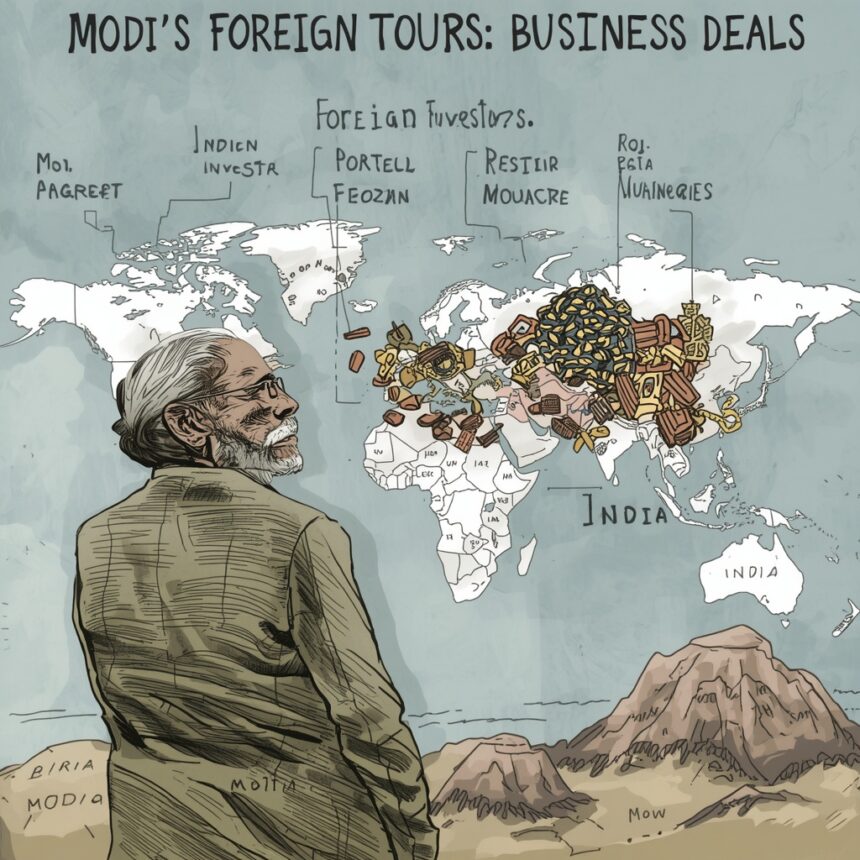
Since assuming office in 2014, Prime Minister Narendra Modi has transformed India’s foreign policy into a highly visible global outreach exercise. More than 80 foreign visits, participation in global summits, repeated high-profile receptions, and the receipt of several top civilian honours from foreign governments have projected an image of strong international acceptance. Yet behind the optics lies a difficult economic question: Have these foreign tours genuinely strengthened India’s economy, or have they primarily helped position India as a massive consumer market for global corporations?

The Modi government repeatedly highlights strategic partnerships, trade agreements, defence cooperation and investment commitments signed during these tours. However, the ground reality reflected in economic data appears far less celebratory. India’s manufacturing sector has not expanded at the pace once promised under “Make in India.” Exports have remained relatively stagnant compared to rising imports, while the rupee continues to weaken against the dollar.
India’s total imports are expected to remain around 700–720 billion dollars in 2025-26, while exports are estimated near 440–450 billion dollars. This leaves a trade deficit exceeding 250 billion dollars. In simple terms, India is spending far more dollars than it earns. The consequences are visible in the weakening rupee, rising inflation and growing pressure on middle-class households.
The rupee, which traded near ₹73 against the US dollar in 2021, has steadily weakened and market projections now suggest that it may move closer to ₹89 or even ₹90 in the coming period if global pressures continue. A weak rupee directly increases the cost of fuel, electronic goods, fertilizers, industrial raw materials and imported technology. Ultimately, ordinary citizens bear the burden through inflation and declining purchasing power.

Despite this structural problem, public discourse is often diverted toward gold consumption and fuel usage by citizens. Government appeals asking people to avoid buying gold or reduce fuel consumption ignore the deeper economic weaknesses driving foreign exchange pressures.
The Real Crisis: Declining Investments and Rising Dependence
India imported crude oil worth nearly 132 to 140 billion dollars during 2024-25, accounting for roughly 4.5 percent of GDP. Gold imports, despite frequent criticism, account for only about 0.7 percent of GDP. The larger concern is not consumer behaviour but the weakening flow of foreign capital into the Indian economy.
Foreign Direct Investment (FDI), one of the key indicators of global investor confidence, has shown a worrying decline. India attracted approximately 59.6 billion dollars in FDI during 2020-21. By 2023-24, that figure had fallen to around 44.4 billion dollars. Even more alarming is the sharp decline in net FDI after accounting for repatriation and withdrawals by foreign companies.
Between April and December 2023, India’s net FDI reportedly fell by nearly 55 percent, dropping to below 10 billion dollars. This indicates that many foreign firms are either slowing expansion plans or moving profits and investments out of India. Foreign Portfolio Investors (FPIs) have also displayed volatility. In 2022 alone, overseas investors reportedly withdrew nearly 17 billion dollars from Indian equity markets.
This trend raises uncomfortable questions regarding investor confidence in India’s long-term economic direction. If India is being projected globally as one of the world’s fastest-growing economies, why are net investment flows weakening?

Equally significant is the growing trend of Indian corporate giants investing abroad. Companies linked to Gautam Adani, Mukesh Ambani, Tata Group, Mittal Group and Jindal Group are aggressively expanding into the United States, Europe, Africa and the Middle East. While global expansion is natural for large corporations, it also reflects concerns about domestic profitability, policy uncertainty and market limitations within India.
The controversies surrounding the Adani Group in the United States have further intensified debates over the relationship between corporate expansion and political influence. Reports suggesting large overseas investment commitments amid ongoing international scrutiny have triggered serious discussions about the priorities of India’s economic elite. Even if such claims remain politically contested, they contribute to growing public scepticism regarding transparency and governance.
Rare Minerals, China’s Dominance and India’s Strategic Vacuum
The global economic battle of the future is no longer centred solely around oil. It is increasingly focused on rare minerals such as lithium, cobalt, nickel, graphite and rare earth elements. These minerals are essential for electric vehicles, semiconductor manufacturing, missile systems, batteries, renewable energy infrastructure and advanced defence technologies.
China recognized this strategic reality nearly two decades ago. Through aggressive investments across Africa and Latin America, Beijing secured mining rights, supply chains and refining capacities for critical minerals. Today, China reportedly controls nearly 85 to 90 percent of global rare earth processing and dominates more than 70 percent of the battery supply chain market.
The United States and European nations are now scrambling to reduce their dependence on China for these critical resources. Europe has launched major infrastructure and mineral partnerships across Africa, while the US is rapidly increasing investments in critical mineral alliances.
India, however, still appears to lack a comprehensive long-term mineral security strategy. Occasional agreements for short-term crude oil reserves with Gulf nations are projected as major diplomatic successes, but they do little to address the larger strategic challenge of securing future industrial resources.
Recent European tours by Prime Minister Modi once again generated headlines, symbolic gestures and ceremonial honours. Yet many economists argue that India’s deeper structural concerns remain unresolved. Large trade agreements often increase imports from advanced economies faster than India’s own export competitiveness improves. As a result, India risks becoming a vast market for foreign products instead of emerging as a self-reliant manufacturing and technology power.
The issue before India today is therefore much larger than foreign tours or international awards. Real national strength is measured not by ceremonial honours abroad but by a strong currency, stable investments, industrial growth, export expansion and strategic economic independence.
If India fails to secure critical mineral supply chains, strengthen domestic manufacturing, improve investor confidence and reduce excessive import dependence, the dream of becoming a global economic superpower may remain largely rhetorical. The coming decade will determine whether India emerges as a production-driven strategic power—or remains primarily a consumption-driven market for stronger global economies…….