

By Ch. V. Prabhakar Rao
Senior Journalist, 9391533339
Viewing Mekedatu solely as Karnataka’s development project oversimplifies a far more complex reality. Equally, dismissing Tamil Nadu’s concerns as merely political ignores the genuine anxieties of millions of downstream farmers whose livelihoods depend on reliable river flows.
For over a century, the Cauvery has been more than a river. It has shaped the political relationship between Karnataka and Tamil Nadu, influenced electoral narratives, triggered mass protests, and repeatedly drawn the intervention of courts and tribunals. Despite colonial-era agreements, the Cauvery Water Disputes Tribunal, and successive Supreme Court judgments, the dispute remains one of India’s most enduring interstate conflicts.
The proposed Mekedatu Multipurpose Reservoir Project has now become the latest—and perhaps the most consequential—chapter in that history.
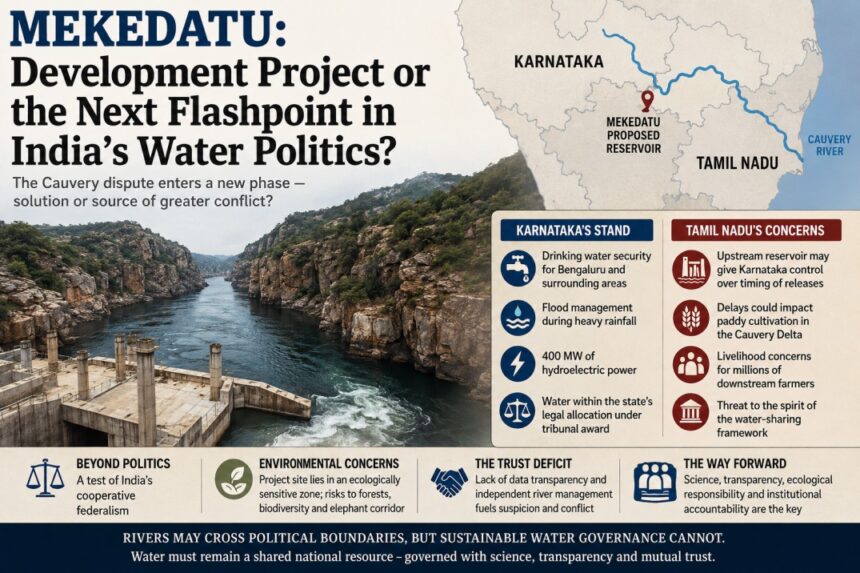
To Karnataka, Mekedatu represents a long-overdue investment in drinking water security, flood moderation, and energy generation. To Tamil Nadu, it raises concerns about upstream control over river flows and the future of millions of farmers who depend on timely releases into the Cauvery Delta.
The debate, therefore, is no longer simply about building a reservoir. It is about balancing development with federalism, environmental sustainability, and interstate trust.

Development Versus Downstream Security
The proposed reservoir at Mekedatu, in Karnataka’s Ramanagara district near the Tamil Nadu border, is expected to have a storage capacity of about 67 TMC (thousand million cubic feet). Karnataka argues that the project is intended primarily to supply drinking water to Bengaluru and neighbouring urban centres, regulate floodwaters during years of heavy rainfall, and generate nearly 400 MW of hydroelectric power.
The state’s central argument is straightforward. Mekedatu, it says, will not alter Karnataka’s legal entitlement under the Cauvery Water Disputes Tribunal award or the Supreme Court’s 2018 judgment. The project, according to Bengaluru, merely seeks to store and manage water that already belongs to the state’s allocated share.

Tamil Nadu’s concerns, however, focus less on allocation than on operational control.

Its argument is that an additional upstream reservoir could enable Karnataka to regulate the timing of water releases, particularly during critical agricultural seasons. The Cauvery Delta and the Mettur Dam depend not merely on the quantity of water received but on its timely arrival. Even temporary delays can disrupt paddy cultivation, reduce crop productivity, and affect the livelihoods of millions of farmers.
Neither argument can be dismissed lightly.
Bengaluru, among India’s fastest-growing metropolitan regions, faces mounting pressure on its water resources. Equally, Tamil Nadu’s delta agriculture has evolved over generations around predictable river flows. The real challenge, therefore, is not determining whose concerns are legitimate—they both are—but designing institutions capable of balancing competing developmental priorities.
Beyond Water: A Test of Cooperative Federalism
The Mekedatu debate has evolved into something much larger than an engineering proposal. It has become a test of India’s model of cooperative federalism.
In Karnataka, the project has increasingly been projected as a symbol of regional development and the state’s water rights. In Tamil Nadu, opposition to Mekedatu has united political parties that otherwise disagree on almost every major issue. As a result, what began as a technical proposal has steadily transformed into a politically charged confrontation, leaving limited space for scientific assessment and evidence-based policymaking.
This politicisation is perhaps the greatest obstacle to any durable solution.
More Read

The Ecological Dimension
The controversy is not confined to interstate politics. The proposed reservoir lies within an ecologically sensitive forest landscape that supports rich biodiversity and functions as an important elephant corridor. Environmental scientists have cautioned that large-scale submergence of forest land, changes in the river’s natural flow regime, and long-term ecological consequences require far more rigorous scientific evaluation before irreversible decisions are made.
Infrastructure development remains essential for a growing economy. Yet sustainability cannot become its casualty. India’s future water security depends not only on constructing reservoirs but also on preserving the ecological systems that sustain its rivers.
The Trust Deficit
Perhaps the most significant lesson emerging from the Mekedatu debate is that India’s interstate water conflicts are driven as much by institutional distrust as by water scarcity.
Transparent, real-time sharing of reservoir data, independent river-basin management authorities, scientifically designed release protocols, and continuous hydrological monitoring could substantially reduce political suspicion. Without such institutional reforms, even projects that satisfy legal requirements are likely to remain politically contested.
Water disputes cannot be resolved by litigation alone. They require institutions that inspire confidence among all stakeholders.
The controversy ultimately underscores a larger truth: rivers may cross political boundaries, but sustainable water governance cannot remain confined within them.
The future of the Cauvery basin will not be secured through court judgments alone. It demands scientific river-basin management, transparent hydrological data, ecological responsibility, institutional accountability, and above all, a genuine commitment to cooperative federalism.
Without these foundations, Mekedatu risks becoming yet another symbol of India’s unresolved interstate water conflicts rather than a model of balanced and sustainable development.
Water must never become an instrument of political mobilisation. It is a shared national resource—one that should be governed through science, transparency, constitutional responsibility, and mutual trust.