

– Ch.V. Prabhakar Rao, Senior Journalist,Ph: 9391533339
If we observe the history of humanity, a clear paradox emerges. Human beings, born with a desire for freedom, have themselves built chains of bondage. Unlike other creatures in nature, which live with love and instinctive harmony, human beings, as civilisation progressed, began creating invisible chains around themselves in the name of power, domination, religion, race, wealth and knowledge. The wars, empires, colonial regimes and religious conflicts of the world ultimately emerged from the desire of one human being to dominate another. Natural human values such as love, freedom and equality have gradually been crushed beneath fear, hatred, jealousy and arrogance. Although civilisation has provided humanity with comforts, it has taken away inner peace.
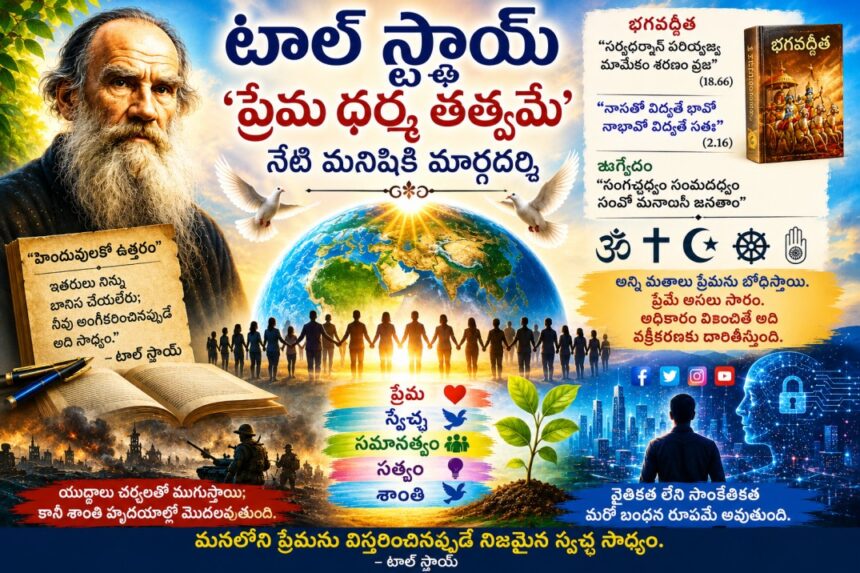
The world-renowned writer Leo Tolstoy analysed this crisis nearly 116 years ago in his famous essay A Letter to a Hindu. Written in 1908 to Taraknath Das, an Indian freedom fighter based in the United States, Tolstoy did not merely criticise British colonial rule. He also explained how the idea of slavery takes root in the human mind. This letter has now been republished in book form by Chintakuntla Sampath Reddy.
In Tolstoy’s view, slavery is not merely a force imposed from outside. It is constructed through the fears, ignorance, blind reverence for authority, religious superstitions and caste- and race-based inequalities that exist within human beings and societies. He articulated, with remarkable clarity, the idea that “Others cannot enslave you unless you accept slavery.”

This idea also has deep connections with Indian philosophical traditions. The words of Lord Krishna in the Bhagavad Gita—
“Sarva-dharman parityajya mam ekam sharanam vraja” (18.66)
—are not merely a message of devotion. They can also be understood as a call to abandon the artificial identities imposed upon the individual—caste, religion, social divisions, fear of authority and other forms of bondage—and to realise the truth. “Mam ekam” may be understood as the inner self, the ultimate truth and love within the individual. Liberation becomes possible only when that truth is realised.

Similarly, the verse—
“Nasato vidyate bhavo nabhavo vidyate satah” (2.16)
—closely resonates with Tolstoy’s philosophy. It declares that the unreal has no permanent existence, while truth can never perish. Empires, wars, nationalistic pride and religious hatred are all temporary constructions. Love, compassion, humanity and truth, however, are enduring values.
Tolstoy’s uniqueness lay in the fact that he sought not the external forms of religion but their inner essence. He saw love as the central principle of the Vedas, the Upanishads, the Gita, the Bible, the Quran, Buddhism and Jainism. That is why he believed that all religions had taught love, but religious institutions had often used violence to protect power and authority.
The Rig Vedic verse—
“Sangachchhadhwam Samvadadhwam Sam Vo Manamsi Janatam”
—calls for collective consciousness, dialogue and mutual understanding. In essence, the core of religion is freedom, love and equality. Yet, throughout history, when religions became intertwined with political power, they often turned into instruments of control. This is precisely where Tolstoy’s criticism is centred. For him, religion was a moral way of life, whereas religious institutions had often transformed themselves into mechanisms serving the pursuit of power.
This is even more evident in today’s world. Modern science and technology have given humanity extraordinary comforts. Yet the same knowledge has also laid the foundations for the war industry, nuclear weapons, digital surveillance and artificial-intelligence-based systems of control. Technology was supposed to liberate human beings, but instead it has increasingly made their thoughts and behaviour subject to the market. Tolstoy had already warned in 1908 that scientific knowledge, when placed in the service of power, could become another form of dogmatism. That warning has become even more relevant today. In the age of social media, individuals may believe that they are thinking independently, while their opinions are increasingly shaped by algorithms, political propaganda and market forces.
From the World Wars to the Russia–Ukraine war, and from the Israel–Palestine conflict to religious violence, wars ultimately end through negotiations. Yet humanity continues to believe that peace can be achieved through power. This is the tragic paradox of civilisation.
Tolstoy’s influence on Mahatma Gandhi assumes great significance in this context. Gandhi developed non-violence not merely as a political weapon but as a philosophy of human liberation. Satyagraha—the insistence of the soul upon truth—is deeply connected with Tolstoy’s idea of the “religion of love.”
The essential nature of human beings is love, freedom and coexistence. But arrogance, fear, jealousy and the desire for domination transform them into violent beings. Civilisation has given humanity technological power, but it has not given it moral clarity. That is why, even as the world progresses materially, human relationships continue to face deep crises.
This is where the continuing relevance of Tolstoy’s message lies. His message does not belong to any one religion, race or nation. It is a warning concerning the future of humanity itself. Civilisation cannot survive without love. Humanity cannot flourish without freedom. Peace is impossible without truth.
Therefore, A Letter to a Hindu is not merely a historical letter. It is a call for human beings to rediscover themselves. True freedom becomes possible only when people live not for domination over others, but to expand the love within themselves and share it with the world. Otherwise, no matter how far humanity advances technologically, it will remain imprisoned within the chains it has built for itself.