Government Indifference to Educational Reform in Telangana – The Real Story Behind an Intellectual’s Resignation
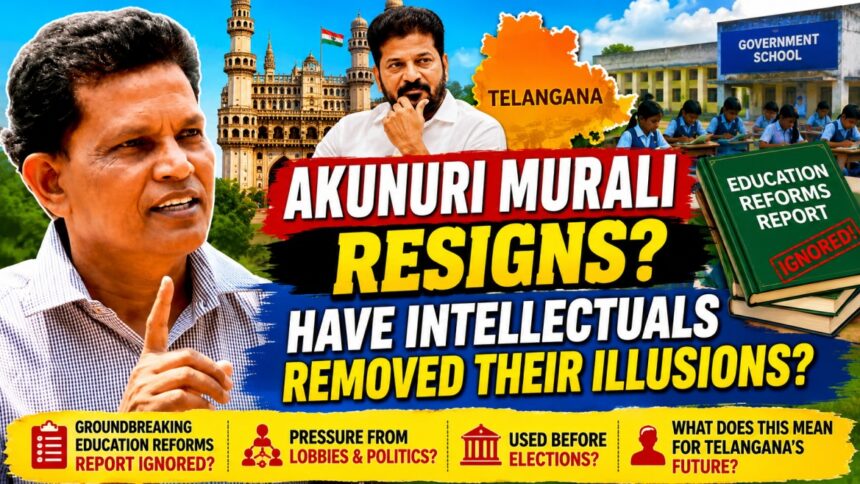
One of the most widely discussed developments in Telangana’s education sector in recent days has been the resignation of Akunuri Murali, Chairman of the Telangana Education Commission and a retired IAS officer. His decision to step down despite his tenure officially extending until September 2026 is not merely a personal decision—it has evolved into a serious question about Telangana’s education system, the government’s commitment to reform, and political ethics.
There is also growing political commentary that the Congress party, which welcomed several voices that had opposed KCR for various reasons, is now gradually distancing itself from many of them after coming to power. Sections of journalists, intellectuals, and civil society groups have begun expressing dissatisfaction with what they describe as the government’s functioning style. Public perceptions are also being shaped by concerns that several election promises remain unfulfilled, while visible lack of coordination among leaders has contributed to a growing image of administrative drift.
It may not be possible to claim that Murali’s report was flawless in every respect. However, what is raising questions is that there has been virtually no serious public discussion on the report itself.
Behind this resignation lies more than the disappointment of an individual. It reflects frustration over an abandoned vision, the disillusionment of a reform-oriented administrator, and perhaps a political culture where individuals are embraced during elections but sidelined once power is secured.

Akunuri Murali is not an ordinary retired official. Throughout his career, he cultivated the image of someone willing to challenge systems and question authority. He publicly criticised the KCR government and actively campaigned during the 2023 Assembly elections, including participating in bus tours urging voters to defeat the BRS government. At that time, he became an important intellectual voice aligned with anti-incumbency sentiment.
Yet critics now ask: has the same Congress government effectively sidelined him? That question is increasingly being discussed among intellectuals, educators, and political observers.
A Reform Report — But Too Difficult to Implement?
More Read

As Chairman of the Telangana Education Commission, Murali submitted a comprehensive report examining structural weaknesses in the state’s education system.
Among his key recommendations were:
- Merging school education administration with the Intermediate Board
- Reviewing teacher pay structures
- Correcting student–teacher imbalance in rural schools
- Consolidating schools with very low enrolment
- Reallocating excess teacher positions in urban areas
- Undertaking comprehensive restructuring of public education
These were not routine administrative suggestions. They involved politically sensitive decisions requiring considerable political will.
The reality in Telangana is complex. Many rural schools reportedly operate with fewer than ten students while employing multiple teachers. At the same time, some urban institutions face staffing imbalances. Meanwhile, increasing numbers of students continue moving toward corporate junior colleges, reflecting declining public confidence in government education.
Under such conditions, reforms appear necessary—but politically difficult.
Did the Government Retreat Under Pressure from the Intermediate Education Lobby?
The most controversial recommendation in Murali’s report was the proposed merger of school and intermediate boards.
If implemented, such reforms could potentially reshape Telangana’s intermediate education landscape and affect the influence of large private junior college networks. This is where, according to critics, the real resistance began.
Intermediate education in Telangana has evolved into a major commercial ecosystem. Large private institutions carry economic influence and often maintain connections across political and media circles.
Supporters of Murali’s proposals argue that reform could reduce existing imbalances. At the same time, teacher associations and sections of junior lecturer groups reportedly expressed opposition to some recommendations.
Critics further argue that influential education interests also shape broader policy debates—including resistance to aspects of the National Education Policy (NEP) 2020 and implementation of measures intended to expand access for economically weaker sections in private institutions.
Whether one agrees with that assessment or not, these concerns form part of the wider debate around education reform.
More than three months after submission of the report, the government has not announced major steps based on its recommendations. Public comments by committees reviewing the report have further strengthened perceptions that the proposals may not align with current policy priorities.
This has led to uncomfortable questions:
- Was the decision effectively made in advance?
- Was the commission largely symbolic?
- Why was there no wider public consultation?
Why Was the Advice of an Experienced Reform Administrator Not Taken Seriously?
Murali’s credentials in education policy did not emerge in isolation.
He was associated with educational reform initiatives and is often linked to advisory contributions during the implementation of the “Nadu–Nedu” school infrastructure programme in Andhra Pradesh, which drew national attention for improving public school facilities.
Few would argue that he lacks administrative experience or understanding of education policy. That is why the government’s apparent unwillingness to engage meaningfully with his report has attracted attention.
Did Congress Benefit from Murali’s Public Credibility?
This is perhaps the sharpest political question now being raised. Was Murali useful during the opposition phase—as a public intellectual criticising the previous government—but less relevant once electoral goals had been achieved?
Such criticism is not unique to Telangana. Across politics, intellectuals, retired officials, and civil society figures often play visible roles during elections, while governance later shifts toward political calculations and competing pressures.
Many observers believe Murali’s case reflects this broader pattern. He was projected as a face of reform, but when it came to implementing difficult recommendations, political caution appeared to prevail. That, critics argue, sends a troubling message: ideas matter only when they fit political convenience.
Is the RERA Chairman’s Resignation Also a Coincidence?
Recent discussions have also referred to the resignation of the RERA Chairman. Two resignations involving major institutions in a relatively short period naturally raise questions. Is there shrinking space for independent thinking inside governance structures? Can only those aligned with government preferences continue? These questions are becoming harder to ignore.
A Warning Signal for Telangana’s Education System
Perhaps the most unfortunate outcome of this episode is that debate has shifted away from education reform itself and toward politics. Government schools in Telangana continue to face significant challenges: falling enrolment in rural areas, uneven staffing patterns, growing dependence on private education, and concerns over quality.
When a comprehensive reform report is produced, the expectation is that it should trigger public debate, expert consultation, and phased evaluation. Instead, the perception that it has been quietly set aside has created doubts about the government’s long-term educational vision.
The Question That Remains
Akunuri Murali’s resignation is not merely about one individual.It raises a larger question: does politics genuinely seek reform—or does it only use the language of reform during elections? Not every recommendation in Murali’s report must necessarily be accepted. Debate and criticism are essential.
But avoiding debate altogether, failing to move even one step toward implementation, and eventually reaching a point where the commission chairman resigns—this, critics argue, reflects a deeper institutional failure.
At one stage, Murali was celebrated as a public intellectual because he challenged the KCR government. Has he now become inconvenient for the present government? That is a question the Telangana government may eventually have to answer.