By Ch. V. Prabhakar Rao
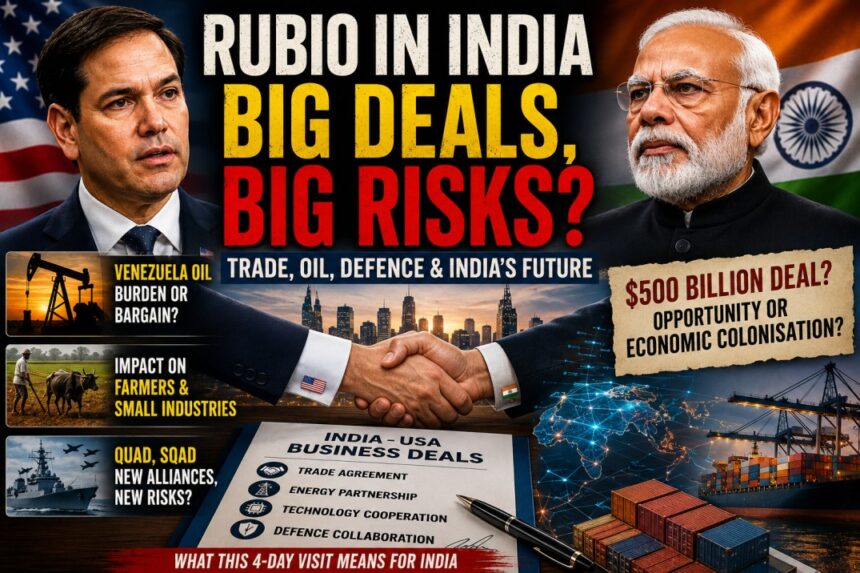
By any diplomatic measure, the four-day visit of US Secretary of State Marco Rubio to India has attracted unusual political and economic attention. Officially, the agenda focused on trade, technology, defence cooperation, energy security and the future direction of the Quad grouping. Yet, as often happens in international diplomacy, the symbolism of where a leader travels, whom he meets first, and what issues remain unstated became almost as important as the formal negotiations.
Rubio’s decision to begin his India visit in Kolkata, including paying tribute at the Missionaries of Charity and honouring Mother Teresa, immediately generated political interpretation. Officially, the visit was presented as humanitarian and cultural engagement. But in diplomatic circles, symbolism is rarely ignored.
Some observers interpreted the stop as a reminder that American engagement with India extends beyond military and economic relations into the wider domain of civil society and values diplomacy. Others cautioned against reading too much into ceremonial gestures.
However, the significance of Rubio’s visit lies less in symbolism and more in what it may indicate about the future direction of India–US relations.

Trade: Partnership, Pressure, or Strategic Realignment?
Economic negotiations appear to have formed one of the strongest pillars of Rubio’s visit.
Public discussions between the two governments centred on expanding bilateral trade, increasing American energy exports, strengthening supply chains, technology cooperation, critical minerals and defence collaboration.
At first glance, these goals appear mutually beneficial. India seeks investment, technology access, advanced manufacturing and export opportunities. The United States seeks deeper access to one of the world’s fastest-growing major economies. But beneath this cooperation lies a structural tension.

India has historically protected:
- agriculture,
- dairy,
- small industries,
- local manufacturing,
- and strategic sectors.
The United States traditionally advocates:
- tariff reductions,
- greater market access,
- stronger intellectual property protections,
- and broader integration into global supply chains.
This creates an uncomfortable question. Can India deepen integration with the global economy without weakening domestic economic resilience? Critics argue that large-scale trade concessions may expose Indian farmers and small industries to competition they are not yet prepared to absorb. Supporters argue the opposite — that India cannot become a global economic power while remaining excessively defensive.
The concern among economists is not trade itself but the conditions under which trade is negotiated. If agreements disproportionately benefit stronger economies while reducing policy flexibility for developing economies, concerns about dependency naturally emerge.
Strategic Autonomy: Is India Narrowing Its Diplomatic Space?
For decades, India’s foreign policy has been guided by strategic autonomy.
India cooperated with:

- Russia for defence,
- America for technology,
- Gulf nations for energy,
- Europe for investment,
- and maintained engagement with Iran.
That balancing model remains visible today. Despite strengthening ties with Washington, India has continued diversified foreign relations and resisted becoming a formal military ally. This is why the claim that India is simply acting under American instructions remains difficult to support based on public evidence.
However, pressure exists. Washington increasingly views India as a central strategic partner in the Indo-Pacific and as an important balancing force against China. India, meanwhile, prefers strategic flexibility rather than entering rigid alliance structures. That difference is becoming more visible.
Quad and the Changing Security Architecture
Marco Rubio’s visit also revived discussion around the future of the Quad. Some analysts argue that Quad has slowed politically. Others believe it is quietly transforming into a platform focused less on military alliance and more on:
- maritime cooperation,
- supply chains,
- semiconductors,
- critical minerals,
- technology standards,
- and regional security coordination.
At the same time, concerns are emerging that the United States may increasingly build overlapping security arrangements with countries like Japan, Australia and the Philippines.
This has led to speculation about whether Washington is constructing a broader Indo-Pacific security architecture that reduces India’s relative importance.
Yet India’s geography, economy, population and Indian Ocean position make complete strategic bypass difficult. India remains too large to ignore. The larger question is whether India can retain strategic independence while participating in security partnerships.
The Venezuela Oil Question: Economic Logic or Geopolitical Adjustment?
Perhaps one of the most sensitive issues surrounding the evolving India–US relationship is energy diplomacy.
A growing political argument suggests that India’s renewed openness toward Venezuelan crude imports is connected not only to commercial interests but also to changing geopolitical expectations.
Some commentators argue that after sustained pressure from Washington to reduce dependence on Russian energy and align with broader Western economic priorities, India may increasingly look toward alternative suppliers, including Venezuela. This interpretation has led critics to raise a difficult question:
Would buying more Venezuelan crude become an economic burden undertaken partly to maintain favourable relations with the United States and President Trump’s administration? Supporters of this concern point to several risks. First, Venezuelan crude involves longer shipping routes and potentially higher logistics and insurance costs compared with some traditional suppliers. Second, Venezuelan crude grades can require refinery adjustments and blending flexibility.
Third, if energy choices become indirectly tied to trade negotiations or diplomatic expectations, India risks narrowing the principle of strategic autonomy that has guided its foreign policy.
From this perspective, critics argue that India should not allow energy purchases to become instruments of geopolitical accommodation. However, there is another side to the argument. India has consistently maintained that energy imports are based on commercial viability and national interest.
Supporters of diversification argue that relying on multiple suppliers -whether Russia, the Middle East, the United States or Venezuela – reduces long-term vulnerability.
For them, diversification strengthens rather than weakens sovereignty. The real issue, therefore, is not Venezuela itself. The issue is whether India retains the ability to choose suppliers based on economic logic instead of diplomatic obligation.
If crude purchases are commercially justified, diversification may strengthen energy security. But if strategic calculations begin outweighing economic calculations, costs could eventually be transferred to Indian consumers, industries and agriculture.
Democracy and Economic Sovereignty
The larger democratic concern is not whether America controls India. The real question is whether India’s institutions remain capable of negotiating from a position of confidence.
Trade agreements, defence partnerships and energy arrangements do not automatically weaken democracy. But weak preparation can.
If policy decisions:
- weaken agricultural competitiveness,
- reduce industrial capacity,
- increase external dependence,
- or narrow regulatory freedom,
then economic integration may create long-term political and social pressures.
At the same time, complete economic isolation would carry its own costs — lower investment, slower innovation and reduced global influence.
India’s challenge is not choosing between Washington and sovereignty.
It is preserving sovereignty while engaging Washington.
A Test of India’s Strategic Confidence
Marco Rubio’s India visit should neither be viewed as diplomatic surrender nor as geopolitical rescue. It is better understood as a negotiation between two ambitious powers with overlapping interests and different expectations.
America seeks markets, strategic cooperation and regional influence. India seeks investment, technology, energy security and strategic respect. Neither side enters the relationship without leverage. The real test will come after the diplomatic ceremonies end.
If India can protect agriculture, strengthen domestic industry, diversify energy, maintain trade balance and preserve strategic autonomy, deeper engagement with America may accelerate national growth.
If not, concerns over unequal integration and economic dependence will become stronger. The future will not be decided by one four-day diplomatic visit. It will be decided by whether India continues to negotiate with confidence — or begins to negotiate from necessity.