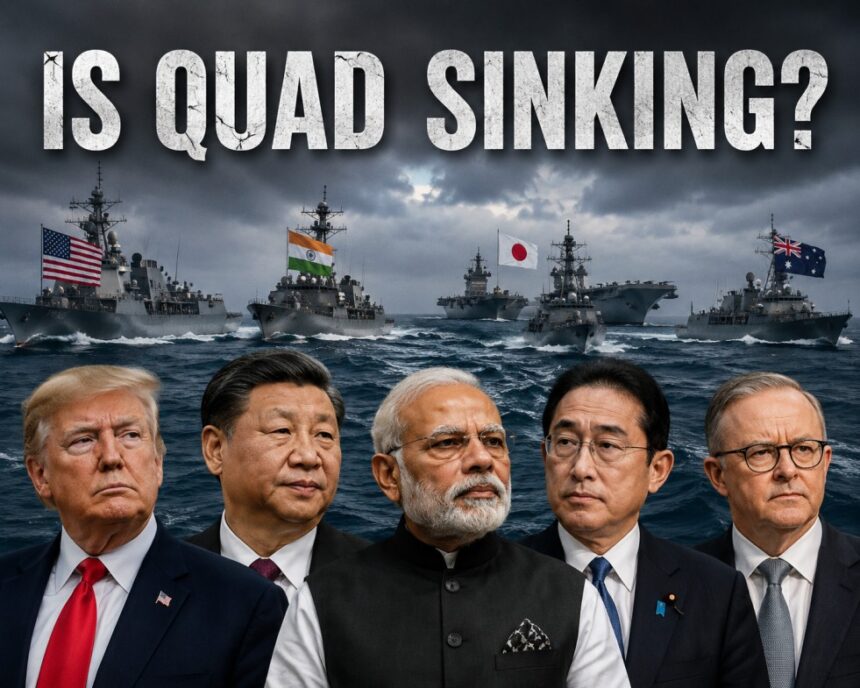
The global geopolitical order is undergoing rapid transformation. The era of a largely US-led international system is gradually giving way to a more multipolar world. At the centre of this transition lies the strategic competition between the United States and China. One of the most prominent platforms shaped by this evolving rivalry is the Quadrilateral Security Dialogue (QUAD). Yet recent developments have raised important questions about QUAD’s direction, relevance, and future role. Against this backdrop, India faces the challenge of redefining its strategic, economic, and diplomatic priorities.
Any discussion on QUAD requires careful analysis rather than political rhetoric. QUAD is neither a formal military alliance like NATO nor merely a symbolic diplomatic platform. It occupies a middle space shaped by strategic coordination and shared interests.
From US–China Competition to QUAD: Understanding the Background
The idea of QUAD first emerged around 2007 as a framework for cooperation among the United States, India, Japan, and Australia in the Indo-Pacific region. Although momentum slowed for some years, the grouping regained strategic relevance after 2017.
It is important to recognise that QUAD was not created solely as a response to China’s military rise. Its broader objectives include securing maritime routes, strengthening supply chains, promoting technological cooperation, enhancing cyber security, and reducing dependence in critical sectors.
The United States has used QUAD as one of several instruments within its Indo-Pacific strategy. However, American foreign policy evolves with changing global realities. At times it emphasises deterrence and strategic competition; at others, it combines competition with engagement. Therefore, viewing QUAD exclusively as an anti-China military bloc oversimplifies its actual role.
Has QUAD Failed, or Is It Changing Its Character?
Some observers argue that the United States is moving away from direct confrontation with China and towards a model of controlled competition and strategic coexistence. As a result, questions are being raised about whether QUAD is losing relevance.
However, the reality appears more nuanced. QUAD remains active and continues to hold strategic consultations. At the same time, its focus has gradually expanded beyond security into areas such as technology, supply chain resilience, infrastructure development, public health, maritime cooperation, and cyber capabilities.

This shift should not necessarily be interpreted as failure. Rather, it reflects a broader transformation in strategic thinking: maintaining influence through partnerships rather than relying only on direct containment.
For India, this transition may create opportunities. India has traditionally pursued a policy of strategic autonomy—maintaining cooperation with multiple powers without becoming dependent on any single bloc.
India’s Strategic Question
The central question for India is not whether to align completely with the United States or distance itself from global partnerships. Instead, the real challenge is how to engage while preserving independent decision-making.
India’s recent foreign policy demonstrates this balancing approach: strengthening ties with the US, maintaining defence relations with Russia, engaging the Global South, and managing competition and dialogue with China simultaneously.
QUAD offers India several strategic advantages:
- Strengthening India’s role in the Indo-Pacific region
- Expanding technological and economic cooperation
- Diversifying global supply chains
- Enhancing maritime security capabilities
- Increasing opportunities in semiconductors, artificial intelligence, and digital infrastructure
At the same time, there are risks that India must carefully manage:
More Read

- Becoming overly entangled in US–China strategic competition
- Facing external pressure on independent foreign policy choices
- Greater security challenges during regional tensions
China’s Rise and the New Strategic Reality
China’s rise has become one of the defining developments of the twenty-first century. Its growth in manufacturing, infrastructure, technology, cyber capability, and space systems has significantly altered global power dynamics.
But China’s rise does not automatically mean American decline. The United States continues to remain one of the world’s leading military, technological, and economic powers. What appears more likely is a future characterised by competition, selective cooperation, and strategic adaptation rather than direct confrontation.
In such an environment, India should avoid becoming dependent on any one power and instead strengthen its own capabilities.
What Should India Do?
First, India’s foreign policy should not be viewed only through the lens of security. Economic strength is increasingly becoming the foundation of geopolitical influence. Investments in manufacturing, research, technology, and defence production must therefore remain a priority.
Second, India should use QUAD not merely as a security arrangement but as a platform for development, maritime cooperation, digital connectivity, and technological innovation. Third, India should continue engaging with China even where competition exists. Dialogue remains essential for border stability, trade, and broader regional balance.
Fourth, India must accelerate efforts to build domestic defence and technological capabilities. Long-term strategic autonomy depends on reducing excessive external dependence.
It would be premature to conclude that QUAD has become irrelevant. Equally, it would be unrealistic to assume that it will evolve into a permanent military alliance on the scale of NATO.
The world is changing. American strategic priorities are evolving. China continues to expand its influence. In this environment, India’s long-term success will depend not on choosing sides but on strengthening its own national capacity.
In international relations, permanent friendships rarely exist—permanent interests do. Whether QUAD expands, transforms, or loses momentum, India’s objective should remain consistent: an independent foreign policy, economic strength, technological self-reliance, and a confident regional and global role.