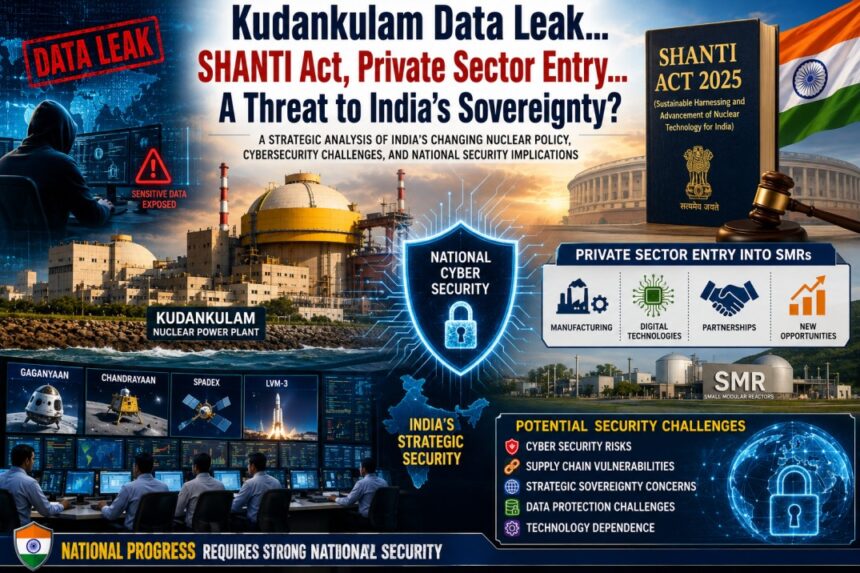
The Privatization of Nuclear Energy:
By Ch. V. Prabhakar Rao, Senior Journalist
India has embarked on an ambitious journey to become a developed nation by 2047. Achieving this vision requires a massive expansion of its power generation capacity, particularly through nuclear energy. Against this backdrop, the Central Government’s SHANTI Act (Sustainable Harnessing and Advancement of Nuclear Technology for India) marks one of the most significant reforms in India’s nuclear policy in over six decades. The Act opens the door for limited private participation in nuclear manufacturing, engineering services, and technology partnerships while the government retains control over strategic nuclear assets.
At the same time, reports of a suspected data leak involving the Kudankulam Nuclear Power Plant have raised concerns within India’s national security establishment. The coincidence of these two developments naturally prompts several important questions. Are they connected? Does the expansion of private participation increase security risks? Or is the timing merely coincidental?
Why Is the Kudankulam Data Leak So Serious?
A nuclear power plant stores far more than administrative records. It contains highly sensitive information relating to reactor design, control systems, communication networks, security protocols, emergency procedures, and operational architecture.
If such information were to fall into the hands of hostile states, cybercriminals, or foreign intelligence agencies, it would represent far more than a simple data breach. It could facilitate cyberattacks, industrial espionage, sabotage, or attacks on critical infrastructure.
However, based on publicly available information, there is currently no official evidence establishing a direct link between the Kudankulam incident and the SHANTI Act or the entry of private companies into India’s nuclear sector. Any such connection remains speculative unless supported by credible investigations.

What Does the SHANTI Act Actually Change?
For decades, India’s nuclear sector has been dominated by government institutions such as:
- Nuclear Power Corporation of India Limited (NPCIL)
- Bhabha Atomic Research Centre (BARC)
- Department of Atomic Energy (DAE)

The SHANTI Act introduces opportunities for private participation in areas such as:
- Small Modular Reactors (SMRs)
- Nuclear equipment manufacturing
- Advanced engineering services
- Digital control systems
- Maintenance and supply-chain management
These reforms are expected to attract investment, accelerate technological development, and position India as a major player in the global nuclear supply chain.

Where Does the Real Risk Lie?
There is a well-known principle in cybersecurity:
“The more entities that handle sensitive information, the larger the attack surface becomes.”
Previously, classified nuclear information remained within a small group of government agencies.
With increased private participation, the ecosystem may expand to include:
- Equipment manufacturers
- Software developers
- Artificial Intelligence companies
- Sensor manufacturers
- Foreign technology partners
As more organizations gain access to critical systems and data, the flow of sensitive information increases. Consequently, the responsibility for protecting that information also becomes significantly more complex.
Small Modular Reactors: Great Opportunity, Greater Responsibility
Small Modular Reactors (SMRs) are widely expected to play a crucial role in the future of clean energy.
Unlike conventional nuclear reactors, SMRs rely extensively on advanced digital technologies, including:

- AI-driven monitoring
- Remote diagnostics
- Digital twin simulations
- Cloud analytics
- Advanced instrumentation and control systems
As a result, cybersecurity becomes just as important as physical security.
The Role of Foreign Companies
Countries such as the United States, France, Russia, Japan, and South Korea are aggressively developing SMR technologies.
India is also encouraging international collaboration to accelerate its nuclear energy ambitions.
While foreign partnerships can enhance technological capabilities, excessive dependence on:
- Foreign software
- Foreign hardware
- Overseas supply chains
could create strategic vulnerabilities if not managed carefully.
Implications for National Sovereignty
There is no evidence to suggest that the SHANTI Act was designed to weaken India’s sovereignty.
However, its implementation raises important policy questions.
Potential risks may arise if:
- Critical digital systems rely heavily on foreign vendors.
- Source code remains outside Indian control.
- Sensitive operational data is hosted on foreign cloud infrastructure.
- Supply-chain security standards are inadequate.
Such vulnerabilities could eventually affect India’s strategic autonomy and technological independence.
What Should India Do?
The success of the SHANTI Act depends not only on attracting investment but also on building one of the world’s strongest nuclear cybersecurity frameworks.
Key priorities should include:
- Zero Trust Cybersecurity Architecture
- Comprehensive Source Code Audits
- Indigenous Digital Control Systems
- Strict Vendor Security Clearances
- Continuous Red Team Cyber Testing
- Insider Threat Monitoring
- Data Localization
- Supply Chain Risk Assessment
These safeguards should become mandatory across the nuclear ecosystem.
The Kudankulam Incident: A Strategic Warning
The Kudankulam episode should not be viewed merely as a political controversy.
Instead, it should serve as a strategic warning.
As India expands its nuclear infrastructure and embraces private participation, the protection of sensitive information must evolve at the same pace.
A nuclear reactor may take five to ten years to build.
A sophisticated cyber intrusion, however, can compromise critical systems within hours.
Conclusion
The SHANTI Act represents a transformative step in India’s nuclear energy journey. It has the potential to attract investment, create high-skilled employment, strengthen energy security, and accelerate technological innovation.
At the same time, it also places greater emphasis on cybersecurity, supply-chain resilience, data protection, and technological self-reliance.
There is currently no verified evidence establishing a direct connection between the Kudankulam data leak and the SHANTI Act. Nevertheless, these developments together raise a fundamental policy question:
“As India opens its nuclear sector to greater private participation and global collaboration, is it simultaneously building one of the world’s most robust cybersecurity and national security frameworks to safeguard its strategic assets?”
The answer to this question will determine whether India’s nuclear expansion becomes not only an engine of economic growth but also a pillar of national security and long-term strategic sovereignty.