

The real test of the Modi government’s economic model lies in reducing import dependence
The Narendra Modi government’s economic record over the past twelve years cannot be reduced either to a catalogue of achievements or to a list of failures. India has undeniably built significant new institutional and digital infrastructure: Jan Dhan accounts, Aadhaar-linked systems, direct benefit transfers, UPI, GST, expanded highways and railways, production-linked incentives, defence indigenisation and a renewed emphasis on domestic manufacturing. Yet, beneath this transformation lies a persistent contradiction. India has emerged as a global leader in digital payments while continuing to depend heavily on China for a wide range of physical goods, industrial components, chemicals, pharmaceutical inputs and even low-value consumer products.
India’s imports from China are estimated to have reached about $132 billion in 2025–26, with the trade relationship continuing to be heavily tilted in Beijing’s favour. The government is now examining domestic alternatives for a large basket of critical imports worth around $51 billion, a move that indirectly acknowledges the limitations of earlier efforts to reduce import dependence. (reuters.com)
The central question, therefore, is not whether India has changed. It clearly has. The more important question is whether the nature of that change has been sufficiently broad-based to generate higher incomes, stable employment and deep domestic manufacturing capabilities.
The success of UPI illustrates this distinction. India’s digital payments infrastructure is a remarkable achievement. UPI has transformed the way millions of Indians transact, and in May 2026 alone, the platform recorded more than 23 billion transactions, according to NPCI data. (npci.org.in) Yet, a payment system is not an income-generating system. A worker receiving wages through UPI does not necessarily earn more because the payment is digital. Digital infrastructure can reduce transaction costs and improve transparency, but it does not automatically create employment or raise productivity.

The same distinction applies to financial inclusion. Jan Dhan accounts brought millions into the formal banking system. This was an important institutional achievement. But opening a bank account is only the beginning of financial inclusion. The real test is whether the account provides access to affordable credit, insurance, pensions, savings and productive economic opportunities. If financial inclusion ends with deposits entering the banking system without a corresponding expansion of productive credit for small enterprises and households, its transformative potential remains limited.

GST presents a similar duality. The creation of a common national market and a more integrated tax system has brought significant benefits to large enterprises and formal supply chains. But for small traders and micro enterprises, compliance costs, documentation, accounting requirements and working-capital pressures have often been disproportionately burdensome. The same regulatory cost that is marginal for a large corporation can be existential for a small enterprise.
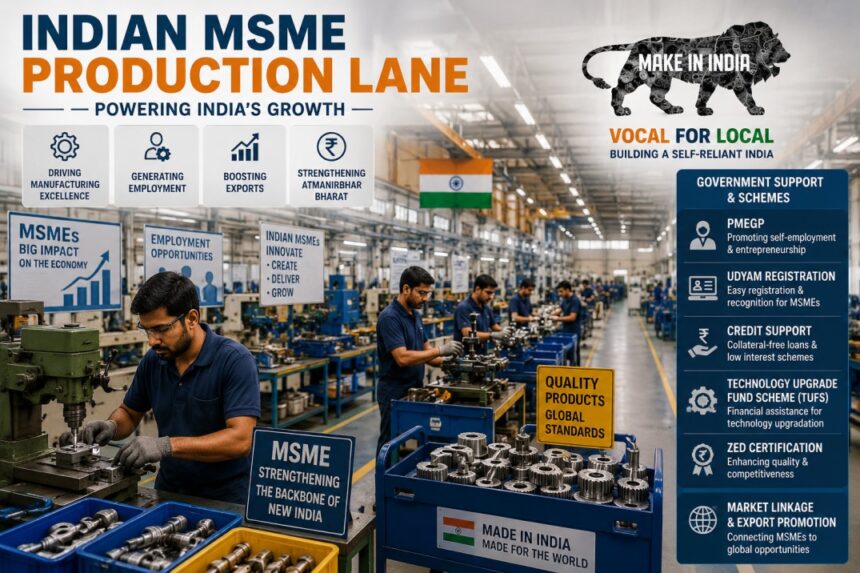
This is particularly significant because India’s employment challenge is closely tied to the health of its MSME sector. The sector accounts for a substantial share of national output and provides livelihoods to millions. Yet the policy architecture of the past decade has often been more visibly oriented towards large investments, infrastructure projects and major industrial corporations than towards the technological upgrading, working capital and market access needs of small manufacturers.

The Production-Linked Incentive scheme represents both the promise and the limitation of the government’s industrial strategy. Official figures show substantial investment, production and employment under the scheme. It would be inaccurate to dismiss the PLI as mere statistical manipulation. The scheme has contributed to capacity creation in sectors such as mobile phones, electronics, pharmaceuticals and automobiles.
However, the more important question is the quality of that production. How much of the value of a product is created domestically? How deep is local supply-chain participation? How many components are manufactured in India? How many small and medium enterprises have been integrated into the production ecosystem?
This distinction is especially important in electronics. India has become a major assembly base for mobile phones, but many critical components—semiconductors, displays, camera modules, batteries and other electronic parts—continue to be sourced from abroad. Thus, “Made in India” does not always mean “made mostly by India”.
The pharmaceutical industry offers an even sharper illustration of this paradox. India is one of the world’s major suppliers of generic medicines. Yet it remains heavily dependent on China for several critical active pharmaceutical ingredients, bulk drugs and intermediates. The Government has stated that China accounted for 73.7% of India’s imports of around 200 identified APIs, bulk drugs and drug intermediates in 2024–25. (pib.gov.in)
The reason is structural. India developed considerable strength in formulations and finished medicines, while China built a more integrated chemical and pharmaceutical supply chain—from basic chemicals and key starting materials to intermediates and APIs. India’s pharmaceutical success, therefore, coexists with a vulnerability at the lower end of the value chain.
The same structural weakness is visible in consumer products. The fact that India imports toys, decorative products, festival lighting and even religious figurines from China is not merely a matter of consumer preference. It reflects the inability of Indian micro-manufacturers to compete with China’s scale, supply chains and production costs.
More Read

A small Indian producer often faces high borrowing costs, expensive raw materials, compliance burdens and limited access to markets. A Chinese producer, operating within a large industrial ecosystem, can benefit from economies of scale and integrated supply chains. Simply asking consumers to “buy local” cannot bridge this structural gap.
This is where the limitations of the Make in India approach become visible. India has succeeded in attracting large investments and creating production capacity in select sectors. But the country has not yet succeeded in building a sufficiently dense ecosystem of small and medium manufacturers that can supply components, materials and intermediate goods to larger firms.
The distinction between investment-led growth and employment-led growth is therefore crucial. A highly automated factory can generate substantial output with relatively few workers. A network of technologically upgraded MSMEs can potentially generate far more employment. India’s challenge is not merely to increase production; it is to create a manufacturing structure that is broad, labour-intensive where appropriate and deeply integrated with domestic suppliers.
This does not mean that India should attempt to eliminate all imports from China. Such a goal would neither be realistic nor economically desirable. China is deeply embedded in global supply chains. The more rational objective is to reduce strategic dependence in critical sectors while maintaining access to competitively priced inputs where necessary.
The next phase of India’s industrial policy must therefore move beyond final assembly. It must focus on the entire value chain: raw materials, chemicals, machinery, components, design, research and development, manufacturing and final products.
India’s pharmaceutical sector cannot be genuinely self-reliant if it produces finished medicines but imports critical APIs. Its electronics sector cannot be fully self-reliant if phones are assembled domestically but their essential components are imported. Nor can “Vocal for Local” become an economic strategy merely by urging consumers to buy Indian products while leaving small producers without affordable finance, technology and market access.
The Modi government’s economic legacy, therefore, remains mixed but significant. It has built important digital and physical infrastructure and has created new policy instruments for industrial expansion. However, the deeper challenge of generating broad-based employment, strengthening MSMEs and reducing dependence on imported industrial inputs remains unresolved.
The next phase of economic policy must ask a more demanding question than whether a product is assembled in India. It must ask how much of its value is created in India.
The distinction is fundamental.
India has built a remarkable digital economy. It now needs to build an equally deep physical production economy.
The ultimate measure of self-reliance will not be the number of products carrying a “Made in India” label. It will be the extent to which the raw material, technology, components, skills and value embedded in those products are Indian.
India has built the architecture of a modern economy. The next challenge is to build the productive depth that can make that architecture truly self-reliant.
