

-Ch. V. Prabhakar Rao, Senior Journalist, 9391533339
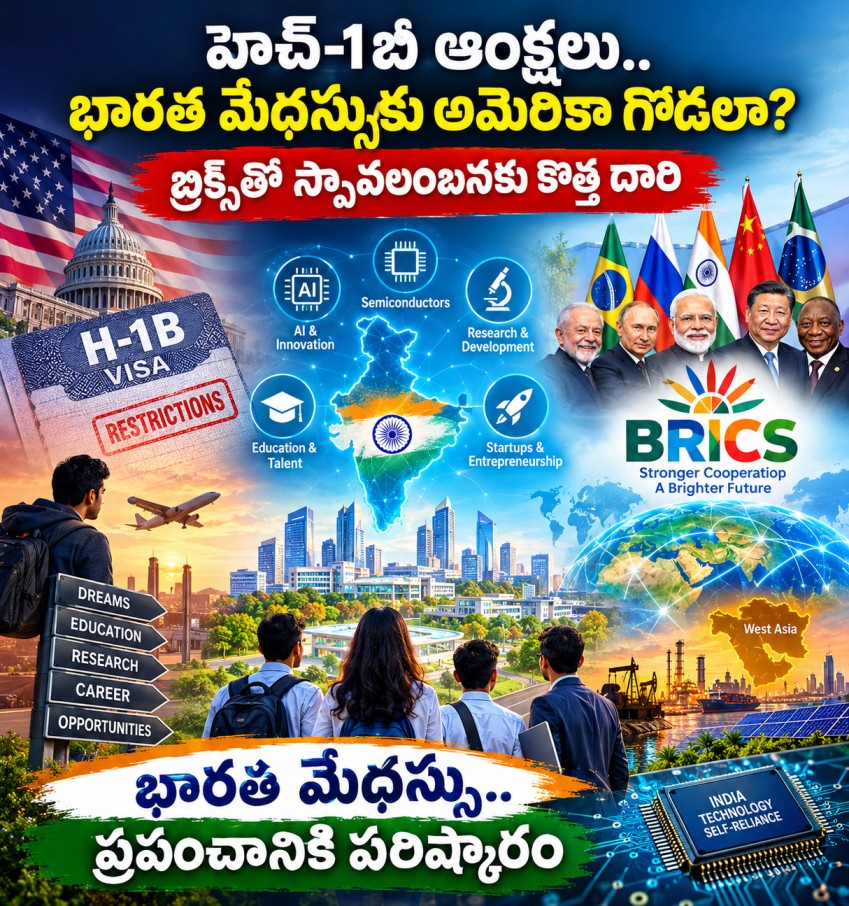
America’s tightening of the H-1B visa regime should not be viewed merely as a setback for Indian professionals. It could become an unexpected opportunity for India to convert decades of brain drain into a sustained phase of brain gain—provided the country is prepared to create the research ecosystem, technological infrastructure and high-value employment opportunities that can attract its talent back home.
The United States has not permanently suspended the H-1B programme. But Washington has imposed a major new barrier on new H-1B entries. Under the September 2025 presidential proclamation, new H-1B petitions involving workers outside the United States were subjected to a $100,000 payment requirement, with specified exceptions. The restriction was initially set for 12 months
For India, the implications are substantial. Indian professionals have historically accounted for the overwhelming majority of H-1B beneficiaries. The United States has therefore benefited enormously from India’s highly skilled human capital in software, engineering, medicine, research, finance and other specialised sectors.
The scale of India’s educational and professional contribution to the American knowledge economy is enormous. In the 2024/25 academic year alone, 363,019 Indian students were studying in the United States, making India the largest source of international students. As per IIE Open Doors website, about 26 per cent were studying mathematics and computer science, and another 18 per cent were studying engineering.

The research contribution is equally significant. In 2024/25, the United States hosted 19,156 Indian international scholars, the highest level recorded for India. Overall, 78 per cent of international scholars in the US were engaged in STEM fields, while 75 per cent came primarily to conduct research.
The question India must now ask is simple but fundamental: Why should Indian talent have to leave India to access world-class laboratories, advanced computing facilities, venture capital, high-end manufacturing and opportunities for frontier research?
This is where the H-1B restrictions could become a strategic turning point.

India does not lack talent. What it has lacked is sufficient scale, continuity and institutional depth in research and innovation. India’s expenditure on research and development remains around 0.64 per cent of GDP—far below major technology powers. If India wants to convert brain drain into brain gain, this ratio must rise substantially, with the private sector contributing much more aggressively to national R&D.
The country needs a national programme designed not merely to bring Indian professionals back, but to give them reasons to return. Universities, IITs, IISc, national laboratories, technology companies, startups and industry should jointly create internationally competitive research programmes. Indian scientists working abroad should be offered visiting professorships, joint laboratories, research grants, startup opportunities and simplified mechanisms for transferring their expertise and intellectual property to India.
The opportunity becomes even more important in the era of Artificial Intelligence.
The 18th BRICS Summit in New Delhi, which concluded on September 13, has placed AI, scientific cooperation, technological innovation and industrial collaboration prominently on the BRICS agenda. The New Delhi Declaration recognises AI as a major driver of economic growth and sustainable development and calls for international cooperation to expand access to AI resources while ensuring safety, security, inclusiveness and reliability. It also calls for cooperation in AI science and innovation and for mitigating technological risks, particularly from the perspective of the Global South.
This is not merely a diplomatic statement. The declaration contains a potentially important framework for building a wider technology ecosystem. BRICS leaders endorsed cooperation in science, technology and innovation, welcomed a BRICS Science and Research Repository, and supported work towards joint research infrastructure and megascience projects. They also welcomed the BRICS STI Framework Programme, which provides a mechanism for funding joint scientific research.
Industrial cooperation has also received a major push. The declaration highlights Industry 4.0, deeper engagement among startups and SMEs, technology transfer, manufacturing competitiveness and innovation. It welcomes the BRICS Incubator Network, further consideration of a BRICS Startup Innovation Fund, and the establishment of the India Centre for BRICS Industrial Competencies. Cooperation is envisaged in intelligent manufacturing, robotics, photovoltaics and advanced digital production technologies, including AI.

This provides India with an opportunity to build something larger than a conventional return-of-talent programme. India could create a BRICS-linked research and innovation ecosystem, connecting Indian universities, laboratories, startups and industries with researchers and companies across Brazil, Russia, China, South Africa and the expanded BRICS membership.
The New Delhi Declaration also calls for cooperation in digital skills, research, capacity building and the creation of a more sovereign and self-reliant digital ecosystem. It proposes a digital public infrastructure repository and encourages collaboration in emerging technologies.
The education dimension is equally significant. BRICS countries have committed themselves to academic and professional mobility, mutual recognition of qualifications, STEM exchanges, digital literacy, ethical use of AI in education and stronger links between technical and vocational education and industry.
For India, the immediate priority should therefore be to identify the technologies in which dependence on foreign ecosystems can become a strategic vulnerability. Artificial intelligence, semiconductor design and manufacturing, quantum computing, robotics, biotechnology, aerospace, defence technology, advanced materials, energy storage and cybersecurity should receive sustained national attention.
India has already begun investing in AI and semiconductor capabilities. But the next phase must move beyond isolated projects. The country needs the entire chain – from research to intellectual property, chip design to fabrication, software to AI models, laboratories to commercialisation, and startups to globally competitive industries.
Semiconductors are a particularly important example. Building fabrication plants is necessary, but it is not enough. India must develop capabilities in chip architecture, electronic design automation, advanced packaging, chiplets, power semiconductors, sensors, photonics, materials and manufacturing equipment. The objective should be to move from “Make in India” to “Design, Invent, Manufacture and Scale in India.”
The same principle applies to AI. India should not restrict itself to using foreign foundation models. It should develop competitive Indian-language models, sovereign datasets, affordable computing infrastructure, AI safety research and specialised models for agriculture, healthcare, education, defence, manufacturing and public administration.
The BRICS framework can complement this effort. Rather than treating BRICS as an anti-Western platform, India should use it as a multipolar technology and research network, while simultaneously maintaining strong technological and economic partnerships with the United States, Europe, Japan, South Korea and other advanced economies.
India’s objective should not be to replace one technological dependency with another. It should be to build strategic technological autonomy.
The H-1B restrictions, therefore, should not produce an emotional debate about whether Indians should remain in America or return to India. The deeper question is whether India can create an ecosystem where a talented Indian engineer, scientist, doctor, researcher or entrepreneur can choose India not because opportunities abroad have disappeared, but because India itself has become an attractive centre of global opportunity.
That requires higher R&D spending, stronger universities, long-term research grants, industry-funded laboratories, easier commercialisation of patents, better startup financing, world-class laboratories and serious incentives for the Indian scientific and technological diaspora.
America may be tightening the door to part of its skilled immigration system. India should respond not by merely complaining about the door, but by building a better destination at home.
The real victory will not be the return of a few thousand professionals. It will be the creation of an Indian ecosystem capable of producing the next generation of scientists, engineers, entrepreneurs, technologies and globally competitive companies.
H-1B restrictions may have been designed to protect American jobs. India should ensure that they also become a catalyst for creating Indian jobs, Indian research and Indian technological power. That is how brain drain can finally become brain gain.
——————–