

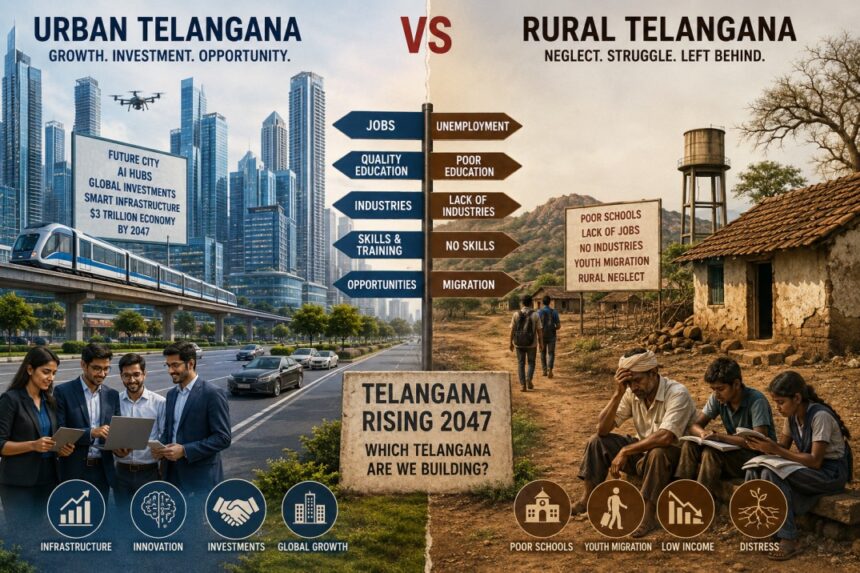
Telangana Rising 2047: An Economic Dream Built on Rural Neglect
– The Urban Growth Story and the Rural Silence
–Ch. V. Prabhakar Rao, Senior Journalist, 9391533339
The Telangana government’s Telangana Rising 2047 vision document presents an ambitious roadmap to transform the state into a $3 trillion economy by 2047. It speaks of Future Cities, AI hubs, global investments, high-speed transport corridors, smart infrastructure, and a globally competitive Hyderabad. On the surface, it is an impressive blueprint for economic expansion. However, a fundamental question remains unanswered:
Who is this development for?

A closer reading suggests that the document is heavily focused on urban growth, infrastructure creation, and investment attraction, while giving insufficient attention to the challenges facing rural Telangana, district economies, unemployed youth, and the public education system. The result is a vision that appears economically ambitious but socially incomplete.
The most striking omission is the absence of a clear employment strategy. The document sets targets for economic growth, but not for job creation. It does not specify how many jobs will be generated, how many will go to rural youth, which districts will benefit, or what opportunities will exist for those outside Hyderabad. Economic growth without measurable employment goals risks becoming a numbers-driven exercise disconnected from people’s lives.

This is particularly significant because Telangana’s greatest challenge over the next two decades will not be GDP growth alone, but employment generation. Every year, thousands of undergraduates, graduates, post graduates enter the labour market. For many of them, especially those from rural backgrounds, the question is not whether Telangana becomes a trillion-dollar economy, but whether they can find meaningful work near their homes.

International experience offers valuable lessons. China’s economic transformation did not rely solely on major cities such as Beijing and Shanghai. Through “Township and Village Enterprises” (TVEs), China created millions of jobs in rural regions by promoting local manufacturing, food processing, engineering units, and small industries. Rural industrialisation became the foundation of national growth.
Telangana’s vision document mentions agriculture and agri-processing, but it stops short of proposing a comprehensive rural industrial strategy. Every district should have a clearly defined economic identity based on its resources, skills, and local strengths. Adilabad could become a centre for forest-based industries, Warangal for textiles, Nizamabad for food processing, Khammam for agro-industries, and Nalgonda, Mahabubnagar for electronics assembly and manufacturing. Such district-level planning is essential for balanced development.
Another major weakness is the treatment of education. The document discusses world-class universities and innovation ecosystems but says little about the quality of government schools, rural colleges, polytechnics, and vocational institutions. No society can build a knowledge economy on a weak educational foundation.
The experience of Finland is instructive. Finland’s success did not begin with elite universities; it began with high-quality public schools in every community. Educational equality became the foundation of economic competitiveness. Telangana should adopt a similar approach by ensuring that every rural school has modern classrooms, science laboratories, digital infrastructure, English communication training, and exposure to emerging technologies such as coding and artificial intelligence.
Germany provides another important lesson. Its highly successful dual education system integrates classroom learning with industry-based training. Students graduate with practical skills and work experience, making the transition to employment much smoother. Telangana’s colleges, ITIs, and polytechnics should be systematically linked with industries so that education leads directly to employability.
The document also underestimates the importance of rural economic diversification. Rural development cannot be reduced to agriculture alone. Sustainable rural prosperity requires manufacturing, services, digital employment, tourism, logistics, handicrafts, renewable energy, and small-scale entrepreneurship. Without these opportunities, migration to Hyderabad will continue, increasing pressure on urban infrastructure while weakening district economies.
A truly transformative vision for 2047 should therefore include a Rural Employment Mission, district-specific industrial strategies, a public education transformation programme, large-scale vocational training, and a rural digital economy initiative. It should guarantee pathways to employment, apprenticeships, or skills training for every young person entering the workforce.
The central weakness of Telangana Rising 2047 is not what it includes, but what it overlooks. It imagines future cities but not future villages. It speaks of global investors but not local producers. It celebrates infrastructure but pays insufficient attention to human capital. It measures growth in dollars, but not in jobs, educational outcomes, or regional equality.
Hyderabad will undoubtedly remain Telangana’s economic engine. But no state can achieve sustainable prosperity if development is concentrated in one metropolitan region while large parts of its population remain on the margins. The future of Telangana will be determined not only by the skyline of Hyderabad, but also by the opportunities available in Adilabad, Mulugu, Narayanpet, Bhupalpally, Nagarkurnool, Mahabubabad, and hundreds of villages across the state.
The real test of Telangana Rising 2047 is therefore simple: will it create a prosperous Hyderabad, or a prosperous Telangana? Until that question is convincingly answered, the vision remains ambitious—but incomplete.
—————————-