By CH.V. Prabhakar Rao, Senior Journalist, 93915 33339
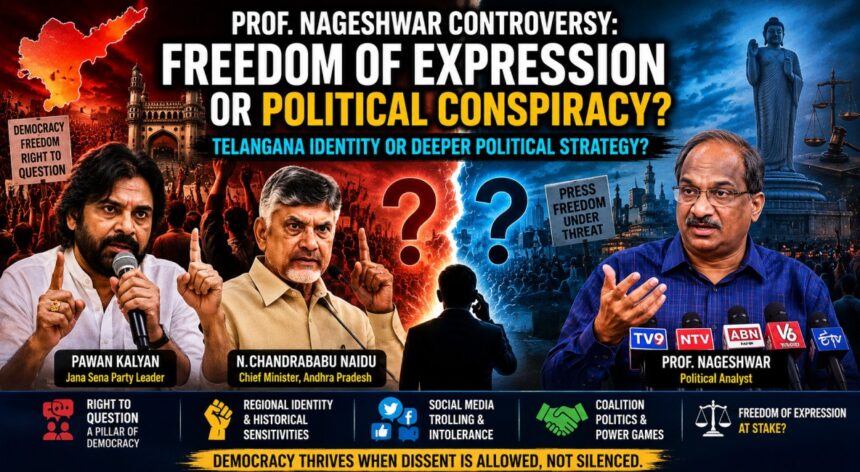
The comments made by Prof. Nageshwar, the sharp reactions from fans of Pawan Kalyan and leaders of the Jana Sena Party, the subsequent police cases, and the press club meetings together indicate that this is not merely a routine media controversy. The episode has evolved into a complex political and social issue where Telangana sentiment, the historical memory of Andhra political dominance, social media trolling culture, and present coalition politics have all converged at once.
The immediate trigger for the controversy was Prof. Nageshwar’s political analysis following Prime Minister Narendra Modi’s visit to Hyderabad, during which Modi visited the residence of N. Chandrababu Naidu and later met Pawan Kalyan after his surgery. In his analysis, Prof. Nageshwar reportedly stated that he had information suggesting Andhra leaders had met Amit Shah regarding the possible arrest of Jagan Mohan Reddy. This immediately raised questions: Was this legitimate political analysis based on internal political inputs, or was it an irresponsible speculative claim?
However, the response to these remarks did not remain within the realm of normal political disagreement. Social media witnessed personal abuse, targeted attacks on Telangana journalists, and reports of legal cases being filed against him. This pushed the issue beyond ordinary criticism and gave it a distinctly political and regional dimension. Later, Prof. Nageshwar clarified that his information had come from “internal sources,” but also announced that he was withdrawing the remarks at the request of Pawan Kalyan, Nagababu, and Nadendla Manohar. That withdrawal itself became another point of political interpretation.
The core question here is: when a political analyst comments on political developments, should it be treated as an exercise of democratic freedom of expression, or should it be portrayed as a political conspiracy?

In any democracy, political analysis, raising questions about power structures, and discussing internal political developments are legitimate parts of journalism and public discourse. If a statement is incorrect, it can be challenged with facts and counterarguments. But when criticism transforms into personal attacks, organized trolling, and regional targeting, it begins to create pressure on freedom of expression itself.
This is where the Telangana dimension entered the debate. One of the central ideas that shaped the Telangana movement was resistance to what many perceived as “Andhra political, economic, and media dominance.” During the united Andhra Pradesh era, questions related to centralized political power, employment opportunities, water resources, and domination of the media and film industries became central to Telangana’s political consciousness. Therefore, when a Telangana-based intellectual or journalist faces aggressive backlash from Andhra political circles, some sections interpret it not merely as an individual controversy, but as a continuation of historical dominance.
At the same time, reducing the issue entirely to an “attack on Telangana” may also oversimplify the matter. The controversy is equally tied to the current political alignments in Andhra Pradesh, particularly the future of Jagan Mohan Reddy, Centre-State political equations, and the BJP–TDP–Jana Sena alliance dynamics.

Comments made by Jana Sena spokesperson Kusumanchi Srinivas that the issue looked “more like a political conspiracy than journalistic analysis” attempted to frame the controversy entirely within a political narrative. In other words, Prof. Nageshwar’s comments were portrayed not as independent analysis, but as part of a deliberate political campaign.
Another important aspect of the controversy is Hyderabad itself. Even after the formation of Telangana, Hyderabad continues to hold immense political, economic, media, and emotional significance for Andhra political and business elites. Hyderabad is not just a city; it remains a major center of finance, cinema, media, real estate, and corporate influence. Andhra Pradesh leaders still maintain deep economic and emotional ties with the city.
This is why some Telangana voices suspect that Chandrababu Naidu still seeks to retain influence over Hyderabad’s political and economic ecosystem. Some even believe that a popular figure like Pawan Kalyan is being used as a socio-political bridge to maintain relevance in Telangana politics. However, there is very little direct evidence for such claims. Much of this perception emerges from historical experiences and political anxieties rooted in the Telangana movement.
The controversy became highly complex because three different truths coexist within it simultaneously.
First, Prof. Nageshwar’s remarks fall within the broader framework of political commentary and democratic debate. Democracies require space for such discussions.
Second, in the age of social media, political fan culture has become highly aggressive and intolerant of criticism. Even a single statement can quickly escalate into organized trolling and public outrage.

Third, the Telangana-Andhra divide is not merely geographical. It is deeply connected to historical memory, fears of domination, cultural identity, and unresolved emotional narratives from the state bifurcation process. As a result, even minor political conflicts can quickly acquire a regional dimension.
The most dangerous aspect of this trend is the merging of three different issues — freedom of expression, regional self-respect, and political criticism — into one emotionally charged narrative. A journalist or analyst can certainly be criticized, but targeting someone based on regional identity weakens democratic discourse. Similarly, portraying every political disagreement as an “attack on Telangana” risks reducing serious debate into emotional polarization.
Today, politics in the Telugu states increasingly revolves around personalities, fan cultures, social media battles, and identity-based mobilization. Therefore, the Nageshwar controversy is no longer limited to a single statement. It has become a larger debate involving media freedom, Telangana identity, Andhra political influence, coalition strategies, and democratic space itself.
At another level, this entire episode also revives concerns about whether certain economic and political interests are once again attempting to dominate Telangana’s public sphere. Constitutionally, every Indian citizen has the right to live and work anywhere in the country. Yet the absence of a Hyderabad-like metropolitan center in Andhra Pradesh continues to shape political and economic realities. Even after twelve years of bifurcation, Andhra Pradesh has not yet developed a comparable urban and economic hub. Questions surrounding employment generation, industrial growth, and long-term economic direction remain unresolved there. These structural realities inevitably contribute to suspicions, insecurities, and political tensions regarding Hyderabad.
Ultimately, this controversy leaves behind a larger democratic question: How safe is the space for political analysis and critical commentary in contemporary India? Are regional sentiments, political fandoms, and state power gradually shrinking the space for free expression and independent journalism? That question remains far more important than the controversy itself.