

From Kaleshwaram to Gurukul Schools: Is the Government Losing Focus?
–By Ch. V. Prabhakar Rao, Senior Journalist
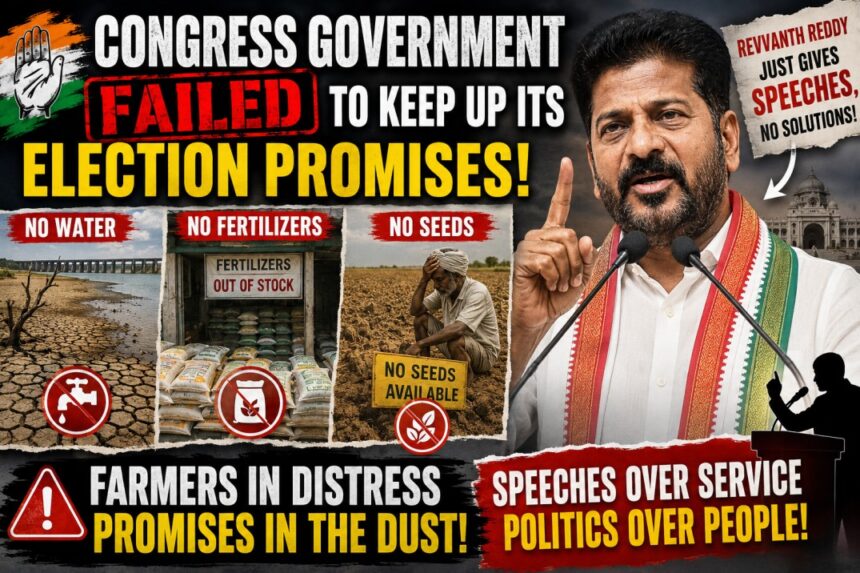
Since assuming office in Telangana, the Congress government has increasingly faced criticism that it has prioritized political messaging over effective governance. Opposition parties, farmer organizations, education experts, and sections of civil society argue that the government lacks a clear administrative direction in crucial sectors such as irrigation, agriculture, education, public finance, and internal governance. While the government maintains that it has launched several welfare initiatives, critics contend that the pace of implementation, administrative coordination, and policy clarity have fallen short of public expectations.
Some of these debates are rooted in publicly available information. Following the sinking of piers at the Medigadda barrage of the Kaleshwaram Lift Irrigation Project in October 2023, both the National Dam Safety Authority (NDSA) and expert committees appointed by the state recommended comprehensive structural safety reviews before full-scale operations could resume. In the education sector, the government has defended the rationalization and merger of schools by citing UDISE+ 2023–24 data, arguing that schools with very low enrolment are being reorganized to improve educational standards. Economic indicators such as the Telangana Budget 2024–25, Reserve Bank of India reports on state finances, data from the Stamps and Registration Department, and observations by industry bodies like CREDAI Hyderabad have also pointed to signs of economic moderation, particularly in the real estate sector. Meanwhile, unresolved promises made during the Telangana statehood movement—including issues such as land pension for those who sacrificed land and livelihoods—continue to generate public dissatisfaction.

Taken together, these issues have fueled criticism that the government is responding more to political controversies than to governance challenges. Questions surrounding the utilization of Kaleshwaram, delays in implementing electoral promises, the slowdown in real estate, controversies over school restructuring, and concerns regarding Gurukul institutions have intensified this perception. Internal differences within the Cabinet, conflicting public statements by ministers, and speculation over leadership have further reinforced concerns about administrative coherence.
Governance Under Scrutiny
Although the Congress government has introduced and expanded several welfare schemes, critics argue that visible progress in key sectors remains limited. Agriculture, irrigation, education, employment generation, industrial investment, and infrastructure continue to dominate public debate. Many observers believe that the government has yet to establish clear priorities, resulting in an administration that appears reactive rather than proactive.

For ordinary citizens, governance is ultimately measured by outcomes rather than announcements. Farmers seek water and agricultural support, unemployed youth expect employment opportunities, students require quality education, and businesses look for policy stability. Political speeches alone cannot substitute for effective administration.
Unfulfilled Movement-Era Commitments
One of the recurring criticisms concerns promises made during the Telangana statehood movement. Activists and social organizations argue that individuals who lost land, livelihoods, or property during the agitation deserve formal recognition and compensation, including the proposed land pension. However, critics say there has been little public clarity regarding the government’s plans, timelines, or implementation strategy.
Questions have also been raised regarding the committee constituted to examine the issue. Some movement activists have criticized the appointment of its chairman, arguing that the selection has generated political controversy rather than broad public confidence. The government, however, has not provided comprehensive public information regarding the committee’s mandate, progress, or implementation schedule. This lack of transparency has contributed to continuing dissatisfaction among sections of the movement leadership.

Irrigation, Kaleshwaram, and Farmers’ Concerns
Agriculture remains one of the most politically sensitive sectors in Telangana. Farmer organizations and opposition parties argue that drought conditions in parts of northern Telangana require urgent irrigation support through the Kaleshwaram project. According to them, available water resources should be utilized wherever technically feasible to minimize crop losses.
Some retired irrigation engineers have publicly argued that limited quantities of water could potentially be lifted from certain locations without major operational difficulties. The government, however, maintains that engineering safety cannot be compromised following the structural concerns identified after the Medigadda incident. Expert committees have recommended comprehensive inspections and repairs before restoring full-scale operations.
This has created a political debate. The opposition accuses the government of using technical concerns as a justification for administrative inaction, while the government insists that public safety and engineering integrity must come first. Ultimately, the central public question remains straightforward: are all available water resources being utilized effectively to protect farmers during difficult seasons?
Economic Slowdown and Real Estate
Economic concerns have also emerged as an important political issue. Industry representatives have pointed to slower property registrations, cautious investor sentiment, elevated borrowing costs, and uncertainty in the real estate market. Monthly registration figures and comments from organizations such as CREDAI Hyderabad have been cited as indicators of moderation in the construction sector.
It would be inaccurate to attribute these developments solely to state government policies, since national economic conditions, interest rates, and broader market trends also influence investment decisions. Nevertheless, critics argue that policy uncertainty, delays in approvals, and insufficient administrative clarity have weakened investor confidence.
Budget documents and RBI assessments indicate growing welfare expenditure alongside fiscal pressures, raising questions about balancing social spending with long-term development investment. The challenge before the government is not merely managing expenditure but creating an environment that encourages sustained economic growth.
Election Promises and Public Expectations
Several election promises remain under public scrutiny. While the government highlights progress in implementing welfare schemes, opposition parties argue that many commitments have either been delayed or remain incomplete.
Governments often cite fiscal constraints, administrative procedures, and revenue limitations when explaining implementation delays. However, from the public’s perspective, election promises represent commitments rather than aspirations. Where delays become unavoidable, citizens generally expect transparency, realistic timelines, and regular public communication. Critics argue that the government has not consistently met these expectations.
School Rationalization and Education Policy
The restructuring of government schools has become another contentious issue. Teachers’ associations have expressed concern that rural education could suffer if schools are merged without adequate planning. The government counters that it is implementing rationalization based on UDISE+ data and emphasizes that the objective is to improve educational quality rather than close schools.
Officially, the government describes the exercise as “rationalization” rather than closure. However, concerns remain regarding increased travel distances for young children, transportation challenges, and the long-term impact on rural communities.
Public confidence could be strengthened through greater transparency regarding the number of schools affected, criteria for mergers, and measures designed to protect students’ interests.
Concerns Regarding Gurukul Institutions
Gurukul institutions have also attracted public attention over issues relating to infrastructure, student welfare, safety, and administration. The government has acknowledged certain concerns and announced corrective measures. Nevertheless, critics argue that meaningful improvements should be judged through outcomes rather than official statements.
Given the important role Gurukul schools play in expanding educational opportunities for disadvantaged communities, ensuring their effective functioning remains an important public responsibility.
Leadership, Cabinet Coordination, and Internal Challenges
Political observers have also focused on reports of inadequate coordination within the Cabinet. Public disagreements among ministers and conflicting statements have created an impression of internal differences.
Media reports and political speculation regarding future leadership have further fueled discussions about unity within the ruling party. While internal debate is not uncommon in democratic politics, prolonged public disagreements can create uncertainty regarding administrative priorities.
Recent public exchanges involving senior leaders have intensified questions regarding party discipline and internal coordination. Whether these differences affect governance will depend largely on the leadership’s ability to maintain policy coherence.
Governance Versus Political Communication
Chief Minister Revanth Reddy’s political speeches have also attracted considerable discussion. Opposition parties argue that the government devotes excessive attention to political criticism instead of addressing governance challenges. The ruling party, however, maintains that responding politically to opposition allegations is an essential part of democratic politics and that public meetings are used to explain government initiatives.
For citizens, however, the fundamental concern is not political rhetoric but improvements in everyday life. Farmers expect irrigation, students expect quality education, businesses seek economic stability, and unemployed youth look for employment opportunities. Governance is ultimately judged through tangible outcomes rather than speeches.
Political analysts have also debated whether there is complete coordination between the Telangana leadership and the national Congress leadership. While the national leadership has consistently emphasized welfare, social justice, and balanced governance, commentators continue to discuss whether state-level decisions fully reflect those broader priorities.
Without access to internal party deliberations, definitive conclusions would be speculative. Nevertheless, effective coordination between party leadership and government administration remains essential for policy consistency.
Every government faces criticism during its tenure. The real test lies in its ability to respond through effective governance rather than political confrontation. Telangana today faces important challenges in irrigation, education, economic development, agriculture, and public administration. Addressing these issues requires policy clarity, administrative coordination, and transparent communication.
The Congress government can no longer dismiss every criticism as routine opposition politics. Equally, opposition parties bear the responsibility of grounding their criticisms in verifiable facts and constructive alternatives.
Ultimately, citizens expect results—not political theatre. Farmers seek water, students seek education, investors seek confidence, unemployed youth seek opportunities, and movement activists seek justice. Whether the Telangana government can convert its electoral promises into measurable governance outcomes will determine how history ultimately judges its tenure.