Ch.V.Prabhakar Rao, Senior Journalist, 9391533339
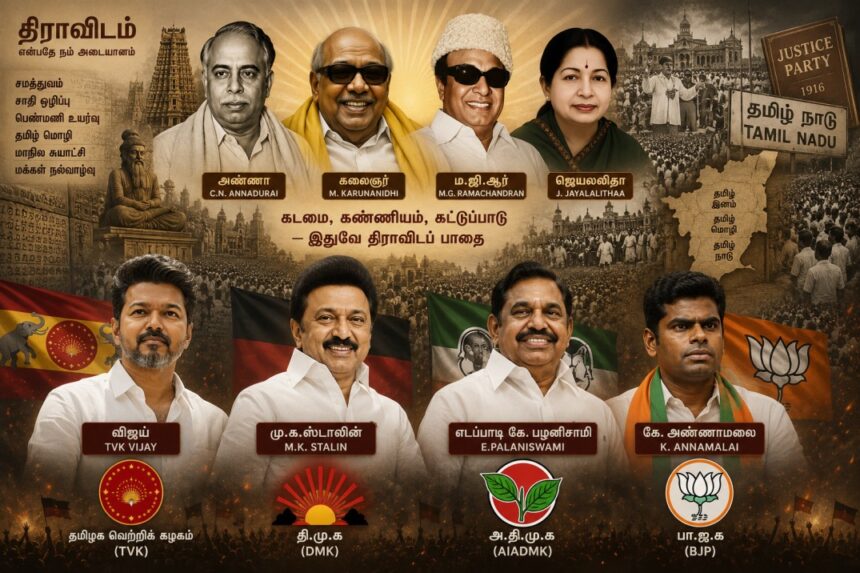
For nearly six decades, Tamil Nadu’s politics has been defined by the dominance of the Dravidian movement. Since the historic victory of C. N. Annadurai and the Dravida Munnetra Kazhagam in 1967, the state has largely remained outside the influence of national political trends. While governments changed between the DMK and the AIADMK, the ideological framework remained broadly Dravidian—centered on Tamil identity, social justice, federalism, linguistic pride, and resistance to cultural centralization. Today, however, there are signs that this long-standing political order is entering a period of transition.
The emergence of actor-politician Joseph Vijay has become the biggest political development in Tamil Nadu in recent years. More than his popularity as a film star, it is his ability to attract young voters, urban middle classes, first-time voters, and politically disillusioned sections of society that has shaken the political establishment. For the first time in decades, a political force outside the traditional DMK-AIADMK framework appears capable of influencing the state’s political direction. Whether Vijay succeeds electorally remains uncertain, but he has already achieved something significant: he has reopened the debate on whether Tamil Nadu needs an alternative to the existing Dravidian political order.
At the same time, the political developments surrounding K. Annamalai have generated another layer of intrigue. As a former IPS officer and one of the BJP’s most visible faces in Tamil Nadu, Annamalai succeeded in expanding the party’s presence far beyond what many expected. Under his leadership, the BJP demonstrated that it could independently attract a substantial vote share, particularly among younger voters and sections of the urban electorate. More importantly, Annamalai emerged as a political figure rather than merely a party functionary.
His social background also carries political significance. Belonging to the influential Kongu Vellala Gounder community of western Tamil Nadu, Annamalai entered a political space traditionally dominated by AIADMK leaders such as Edappadi K. Palaniswami. The Kongu belt—covering Coimbatore, Erode, Tiruppur, Salem, Namakkal, and Karur—has long been one of the most economically dynamic and politically influential regions of the state. Any leader capable of mobilizing this social bloc automatically becomes a significant player in Tamil Nadu politics.

The growing speculation surrounding Annamalai’s future reflects a larger political reality. Over the past decade, the BJP has struggled to establish itself as a dominant force in southern India. The party’s core ideological framework, which has proven highly successful in northern and western India, has encountered limitations in states with strong regional identities and distinct cultural traditions. Tamil Nadu, in particular, has consistently demonstrated that political narratives centered solely on religious nationalism are insufficient to displace deeply rooted regional political cultures.
This has led many observers to wonder whether the BJP is rethinking its southern strategy. Instead of promoting a direct replication of North Indian political models, the party may be exploring region-specific narratives anchored in local cultural identities. In Tamil Nadu, that could mean a politics that combines Tamil pride, spiritual traditions, regional aspirations, and cultural conservatism without appearing as an external ideological imposition. Annamalai, with his youth, communication skills, and regional roots, appears well suited to such an experiment.
Yet the challenge facing both Annamalai and the BJP is that Tamil Nadu’s political landscape cannot be understood solely through ideological debates. Social coalitions continue to play a crucial role. While caste politics in Tamil Nadu is often less visible than in northern India, it remains deeply influential. Communities such as Gounders, Vanniyars, Thevars, Nadars, Mudaliars, and various Dalit groups continue to shape electoral outcomes. The traditional social alignments that sustained both the DMK and AIADMK are now showing signs of fragmentation, creating opportunities for new political formations.

Among these changing social dynamics, Dalit politics may emerge as one of the most decisive factors in the coming decade. Dravidian parties have long claimed the legacy of social justice, yet many Dalit intellectuals and activists argue that political representation and leadership opportunities have remained uneven. A younger generation of Dalit voters is increasingly concerned not only with identity and social dignity but also with education, employment, entrepreneurship, and access to political power. Any emerging political force capable of addressing these aspirations could fundamentally alter Tamil Nadu’s electoral equations.
Similarly, the political behavior of religious minorities is becoming increasingly important. Muslims and Christians together constitute a significant voting bloc and have traditionally aligned with the DMK-led coalition. Their support has been driven partly by ideological concerns regarding the BJP and partly by confidence in the secular positioning of Dravidian parties. However, Vijay’s arrival introduces a new variable. His attempt to construct a broader Tamil identity politics rather than a narrowly sectarian platform may allow him to attract support from sections of minority communities, particularly younger voters who are seeking alternatives to established political arrangements.
The Congress also faces a strategic dilemma. Although it has been reduced to a junior partner in Tamil Nadu politics, it still retains a substantial residual vote base. For decades, the party’s survival has depended largely on alliances. The emergence of new political actors such as Vijay could force Congress to reconsider its long-term strategy. Whether it remains permanently attached to the DMK or seeks new political partnerships may become a critical question after 2026.
Smaller caste-based and regional parties face an even greater challenge. Parties representing Vanniyar, Dalit, and other specific social groups have traditionally exercised influence through coalition bargaining. However, if Tamil Nadu evolves into a genuinely multi-polar political system with four or five major competitors, these parties may find it increasingly difficult to maintain their traditional leverage. Their future relevance may depend on their ability to adapt to changing social realities rather than relying solely on established identity-based politics.
What makes the current moment particularly significant is that Tamil Nadu’s political transformation is not occurring in isolation. Across southern India, political parties are experimenting with new social coalitions and regional narratives. National parties, especially the BJP, increasingly recognize that southern states require distinct political approaches. The future of southern politics may therefore depend not on importing political models from elsewhere but on creating locally rooted alternatives capable of addressing regional aspirations.
In this broader context, the rise of Vijay and the uncertainty surrounding Annamalai represent more than individual political stories. They symbolize a deeper search for a new political language in Tamil Nadu. One seeks to mobilize youth, aspiration, and change. The other represents an attempt to reconcile cultural conservatism with Tamil regional identity. Both reflect the growing sense that the political framework which has governed Tamil Nadu since 1967 may no longer be sufficient to address the expectations of a new generation.

The 2026 Assembly election may therefore become one of the most consequential elections in the state’s history. It will not simply determine who forms the next government. It may determine whether Tamil Nadu remains within the traditional Dravidian political paradigm, reinvents that paradigm for a new era, or begins moving toward an entirely different political future. The answer will be shaped not only by political leaders but also by young voters, Dalits, minorities, regional communities, and an increasingly aspirational middle class. For the first time in decades, Tamil Nadu’s political future appears genuinely open—and that is what makes the current moment so historically significant.
———–