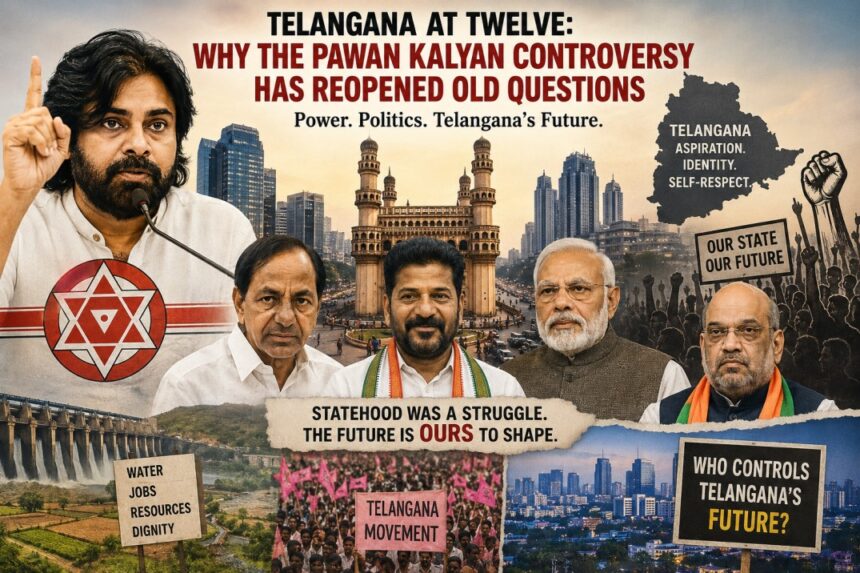
Telangana at Twelve: Why the Pawan Kalyan Controversy Has Reopened Old Questions
By Ch.V.Prabhakar Rao, Senior Journalist.
Here is a rewritten 1000-word English editorial that sharpens the political argument while focusing on power structures, political strategy, and Telangana’s aspirations rather than on people based on regional origin.
Twelve years after the formation of Telangana, the state finds itself confronting some uncomfortable questions that many believed had been settled in 2014. The recent controversy surrounding Jana Sena Party chief Pawan Kalyan’s political entry into Telangana is not merely about one politician, one party, or one press conference. It has become a symbol of larger anxieties regarding political influence, economic power, and the future direction of Telangana’s statehood project.
To begin with, no democratic argument can be made against Jana Sena contesting elections in Telangana. India is a federal democracy, and every political party has the constitutional right to expand beyond its original geographical base. Several regional parties have attempted to build political organizations in other states. Therefore, the issue is not whether Pawan Kalyan or Jana Sena can participate in Telangana politics.

The real issue is how and when such an entry is being made, and what political messages it conveys to a society that still carries the memories of one of India’s most significant statehood movements.
For Telangana, June 2 is not just another government celebration. It marks the culmination of nearly six decades of political struggle, social mobilization, and demands for self-governance. It represents the aspirations of generations who believed that Telangana’s resources, opportunities, and identity had been subordinated within the framework of united Andhra Pradesh. Statehood was not merely an administrative exercise; it was a movement rooted in questions of dignity, representation, and regional self-determination.
Against this backdrop, Pawan Kalyan’s decision to announce his party’s Telangana ambitions around Telangana Formation Day inevitably attracted scrutiny. Many Telangana supporters felt that the timing failed to recognize the emotional and historical significance of the occasion.

The controversy is further complicated by Pawan Kalyan’s own political history. Over the years, he has repeatedly spoken about the emotional pain caused by the bifurcation of Andhra Pradesh. He has publicly stated that the division deeply affected him and that the concerns of people in Andhra Pradesh were ignored during the process. Such views are understandable from the perspective of those who experienced bifurcation as a loss.
However, Telangana views the same event very differently. For many in Telangana, statehood represents liberation from what they perceived as decades of political and economic marginalization. Consequently, when a leader who previously expressed strong emotional opposition to bifurcation seeks political space in Telangana, questions naturally arise about his understanding of Telangana’s historical experience.
Yet reducing the debate solely to Pawan Kalyan would be a mistake. The larger concern lies in the political context surrounding his entry.
Many observers believe Telangana is entering a period of significant political realignment. The Congress government is attempting to consolidate its position after coming to power. The BJP continues its search for a viable pathway to expand its influence in the state. Regional political forces are recalibrating after the decline of the Bharat Rashtra Samithi’s dominance.
Within this environment, Jana Sena’s Telangana initiative is being interpreted by some as part of a broader political strategy rather than an isolated organizational decision. Whether this perception is accurate or not, it has gained traction because of the wider political circumstances.
The subsequent controversy involving political analyst Professor Nageshwar, legal complaints, social media attacks, and aggressive online campaigns transformed a routine political announcement into a larger debate about Telangana’s future. The discussion quickly moved beyond one leader and began touching on deeper issues concerning political power and economic influence.

At the heart of this debate lies a question that has never entirely disappeared from Telangana’s political consciousness: Who controls Telangana’s future?
It is important to clarify that Telangana’s movement was never fundamentally directed against ordinary people from Andhra Pradesh. Hyderabad itself has grown into a global city because of contributions from people belonging to different regions, languages, and communities. Telangana’s success depends on openness, diversity, and economic integration.
The concern expressed by many Telangana intellectuals and activists is not about migration or cultural exchange. Rather, it is about the concentration of political and economic power in the hands of influential networks that may seek to shape Telangana’s future according to interests that do not necessarily align with the aspirations that gave birth to the state.
This distinction is crucial.
The Telangana movement emerged from the belief that decisions concerning water resources, employment, education, public investment, and development priorities were disproportionately influenced by political and economic elites. Whether one agrees with every aspect of that argument or not, it remains central to Telangana’s political identity.
Twelve years after statehood, some observers fear that similar patterns may be re-emerging in new forms.
The reason is simple: Hyderabad.
Today, Hyderabad is not merely the capital of Telangana. It is one of India’s most valuable economic hubs. The city has become a major center for information technology, pharmaceuticals, education, healthcare, real estate, and global investment. Its economic significance extends far beyond state boundaries.
As a result, Hyderabad naturally attracts political attention.
The question many Telangana supporters raise is whether this attention is motivated primarily by democratic engagement or by a desire to influence the economic and political direction of a highly successful metropolitan region.
This concern becomes particularly relevant when viewed alongside broader political developments. Symbolic events, such as the unveiling of NTR’s statue in Hyderabad and the political messaging surrounding such occasions, have generated debate regarding the re-emergence of narratives associated with the united Andhra Pradesh era. While some see these events as legitimate tributes to historical figures, others interpret them as attempts to revive political symbolism that Telangana’s statehood movement sought to challenge.
At the same time, speculation about future political alliances, realignments, and possible shifts in loyalty among major political actors has created a sense of uncertainty within Telangana politics. Comparisons with political developments in states such as Maharashtra may be premature, but they reflect growing concerns regarding political stability and external influence.
In this volatile environment, Pawan Kalyan’s entry into Telangana politics has become a catalyst rather than a cause. It has brought dormant anxieties back into public discussion.
The central issue is not whether leaders from outside Telangana can participate in Telangana politics. The issue is whether Telangana’s political evolution will continue to be guided by the aspirations that shaped the statehood movement or whether it will become increasingly influenced by external political and economic calculations.
As Telangana enters its second decade, the challenge before its people is not to reject democratic competition or economic cooperation. Rather, it is to ensure that development does not come at the cost of political self-respect, regional autonomy, and democratic accountability.
The Telangana movement was built upon the principle that the people of the region should have the primary voice in determining their own future. That principle remains as relevant today as it was before 2014.
The controversy surrounding Pawan Kalyan may eventually fade from public attention. But the questions it has raised are likely to remain. Who shapes Telangana’s future? Who benefits from Hyderabad’s growth? And how can Telangana preserve the spirit of self-governance that inspired its creation?
These are the debates that will define the next chapter of Telangana’s history.