Food Security Act Amendment: An Analysis in the Interest of India’s Poor
The debate over the proposed amendments to India’s National Food Security Act (NFSA), 2013 has triggered sharp political reactions across the country. Several Opposition parties have accused the Union Government of attempting to weaken one of India’s most important welfare legislations, while the Centre maintains that the proposed changes are intended to improve transparency, eliminate fake beneficiaries, and ensure that subsidies reach only genuine recipients. Beyond political rhetoric, however, the real issue is whether the amendments will strengthen food security for the poor or unintentionally deprive deserving families of their basic right to food.

The National Food Security Act was enacted in 2013 with the objective of providing highly subsidized food grains to nearly two-thirds of India’s population. Today, it remains one of the world’s largest food security programmes, covering more than 80 crore beneficiaries through the Public Distribution System (PDS). For millions of low-income families, migrant workers, agricultural labourers, urban poor, widows, and elderly citizens, the monthly supply of subsidized rice or wheat is not merely a government benefit—it is a lifeline.
The Union Government argues that the welfare system must evolve with changing technology and governance standards. According to the Centre, digitisation, Aadhaar-based verification, and periodic revision of beneficiary databases are necessary to eliminate duplicate and fake ration cards, reduce corruption, prevent diversion of subsidized food grains, and ensure that public funds are spent efficiently. Officials also contend that removing ineligible beneficiaries will create room for genuinely deserving families who are currently excluded from the system.
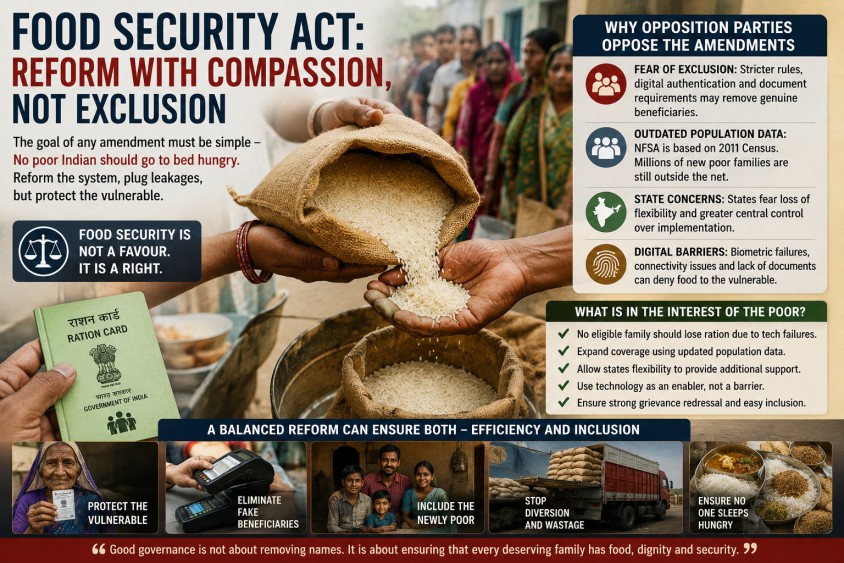
Opposition parties, however, see the issue differently. They argue that while eliminating corruption is important, the proposed amendments could unintentionally exclude genuine beneficiaries. Millions of poor Indians continue to face difficulties in updating documents, linking Aadhaar, or completing biometric authentication. Elderly people often experience fingerprint authentication failures, tribal communities live in areas with poor internet connectivity, migrant workers frequently change their place of residence, and homeless individuals may lack proper documentation altogether. Opposition leaders warn that if technology becomes a mandatory condition for receiving food, administrative errors could deny food to the very people the law was designed to protect.
Another major concern relates to beneficiary coverage. The National Food Security Act continues to rely largely on population estimates derived from the 2011 Census. During the past fifteen years, India’s population has increased substantially, and millions of new households have been formed. Economists and welfare experts argue that the country’s food security programme should first expand to include these newly eligible families before removing existing beneficiaries. They point out that the real challenge today is not only identifying fake ration cards but also ensuring that newly poor families are not left outside the welfare net.

States such as Tamil Nadu have expressed particularly strong reservations. Tamil Nadu has long operated one of India’s most successful and nearly universal Public Distribution Systems. Successive governments in the state have treated food security as a universal welfare measure rather than a narrowly targeted subsidy. The state fears that greater central control over beneficiary identification or implementation could undermine its own welfare model, which has historically minimized exclusion by ensuring broad coverage.
It is in this context that Tamilaga Vettri Kazhagam (TVK) president Vijay appealed to Prime Minister Narendra Modi not to dilute the Food Security Act. Vijay argued that any amendment should prioritize the interests of poor families and avoid creating procedural barriers that could deprive vulnerable citizens of food assistance. His intervention reflects Tamil Nadu’s long-standing political consensus that food security is a basic social responsibility of the state and should not become overly dependent on technical or bureaucratic requirements.
From the government’s perspective, however, maintaining outdated beneficiary databases also creates injustice. Officials argue that fake beneficiaries divert valuable public resources that could otherwise support genuine poor families. Leakages in the Public Distribution System have historically imposed significant financial costs on the exchequer. By introducing digital verification and better data management, the government believes that welfare delivery can become more transparent, accountable, and efficient.

The debate, therefore, is not simply between supporters and opponents of reform. Both sides raise legitimate concerns. The government is justified in seeking to eliminate corruption, improve efficiency, and prevent misuse of taxpayer-funded subsidies. At the same time, the Opposition is equally justified in demanding safeguards to ensure that no deserving family loses access to food because of documentation problems, biometric failures, or administrative mistakes.
From the perspective of India’s poor, the ideal reform should combine efficiency with compassion. Technology should be used to strengthen welfare delivery rather than create barriers to access. Every genuine beneficiary should have alternative mechanisms for verification if biometric authentication fails. Beneficiary coverage should be updated to reflect current population realities, and state governments should retain sufficient flexibility to supplement central food security programmes according to local needs.
Ultimately, the success of any amendment to the National Food Security Act should not be measured by the number of ration cards cancelled or by the amount of subsidy saved. Its true success will be determined by whether every deserving Indian continues to receive affordable food without interruption. Good governance requires both fiscal responsibility and social justice. Eliminating fake beneficiaries is important, but protecting genuine beneficiaries is even more essential. In a country where millions still depend on subsidized food for survival, reforms must strengthen the safety net rather than weaken it.
The debate over the Food Security Act is therefore not merely a political contest between the Centre and Opposition-ruled states. It is a test of India’s commitment to balancing administrative efficiency with the constitutional promise of ensuring dignity, equality, and food security for every citizen. Any reform that achieves both objectives will truly serve the interests of India’s poor.