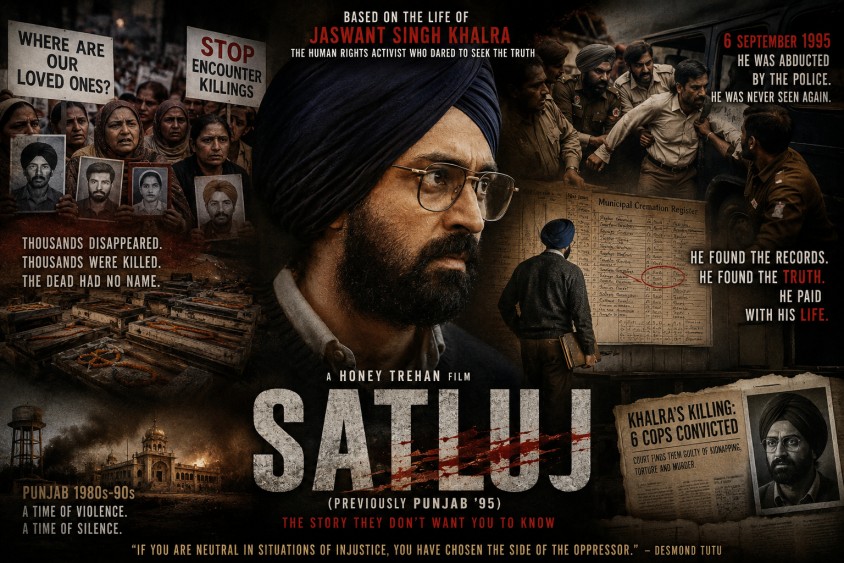
Satluj (Punjab ’95’):
How the story of Jaswant Singh Khalra became one of India’s most controversial films
By iViewBharath Editorial Desk
Few periods in independent India’s history remain as politically sensitive and emotionally charged as Punjab during the late 1980s and the first half of the 1990s. It was a time when the Khalistan insurgency, militant violence, and an unprecedented counter-insurgency campaign transformed the state into one of the country’s most volatile regions.
Thousands of civilians, police personnel, political leaders, and militants lost their lives. While security forces eventually succeeded in crushing the insurgency, allegations of enforced disappearances, illegal detentions, custodial killings, fake encounters, and secret cremations also emerged, raising difficult questions that continue to resonate decades later.
It is this deeply contested chapter of Indian history that forms the foundation of Satluj, originally titled Punjab ’95.

Directed by Honey Trehan and starring Diljit Dosanjh, the film is based on the life of human rights activist Jaswant Singh Khalra, whose investigation into alleged human rights violations during Punjab’s counter-insurgency operations made him an internationally recognized figure.
The Man Behind the Story
Born in 1952 in Punjab’s Tarn Taran district, Jaswant Singh Khalra was not a politician or a journalist. He was a bank employee who gradually became involved in human rights activism through the Shiromani Akali Dal’s Human Rights Wing.
During the height of Punjab’s insurgency, hundreds of families claimed that their relatives had disappeared after being taken into police custody. Khalra began examining municipal cremation registers and public records in Amritsar, Tarn Taran, and surrounding districts.

His investigation led him to allege that thousands of unidentified bodies had been secretly cremated without informing their families or following due legal procedures. He presented these findings before Indian authorities and international human rights organizations, drawing global attention to the issue. His campaign, however, came at an enormous personal cost.
On September 6, 1995, Khalra was allegedly abducted outside his home. He never returned. Subsequent investigations and court proceedings resulted in the conviction of several police officials in connection with his kidnapping and murder.
What Does Satluj Portray?
The film follows Khalra’s transformation from an ordinary citizen into a determined investigator seeking answers for families of the disappeared.
Through municipal records, eyewitness accounts, and official documents, he attempts to uncover what he believes to be systematic human rights violations during Punjab’s anti-insurgency operations.
The film is not structured as a courtroom drama or an action thriller. Instead, it explores the moral conflict between state power and individual conscience, depicting the immense personal risks faced by those who challenge powerful institutions.
Rather than presenting a simple political narrative, Satluj asks uncomfortable questions about justice, accountability, and the responsibilities of democratic governments during periods of internal conflict.

Why Did the Film Become So Controversial?
Few films in recent Indian cinema have faced the level of scrutiny experienced by Punjab ’95. According to director Honey Trehan, the Central Board of Film Certification (CBFC) initially recommended 21 cuts, which reportedly expanded to 127 suggested modifications. Among the reported recommendations were changing Jaswant Singh Khalra’s identity, removing references to certain police officials, altering locations, and presenting the narrative as fictional rather than biographical.
The filmmakers reportedly refused to accept many of these changes, resulting in years of delay before release.
The film was eventually retitled Satluj. Although it briefly appeared on the OTT platform ZEE5 in July 2026, it was subsequently withdrawn in India. The platform cited “current circumstances” without publicly detailing the reasons. No formal public notification of a government ban was issued.
The Larger Debate
The controversy surrounding Satluj extends far beyond cinema. Supporters argue that the film highlights an important human rights story and reminds democracies that counter-terrorism operations must remain accountable to the rule of law.
Critics contend that portraying only allegations against state agencies, without fully reflecting the scale of militant violence during the Khalistan insurgency, risks presenting an incomplete historical picture. Both perspectives illustrate why Punjab’s history continues to evoke strong emotions even three decades later.

History Is Rarely Black and White
Any honest assessment of Punjab’s insurgency must acknowledge two realities simultaneously.
The Khalistan movement witnessed brutal militant violence that claimed thousands of innocent lives, including civilians, public servants, political leaders, and police personnel. Restoring order required one of the most extensive counter-insurgency operations in independent India.
At the same time, allegations of excesses committed during those operations led to judicial inquiries, criminal investigations, and continuing debates over human rights and accountability.
Jaswant Singh Khalra’s story represents one important chapter within this larger and far more complex historical narrative.
Cinema as a Mirror of Democracy
Films based on controversial historical events inevitably provoke debate. That is the nature of democratic societies. Whether audiences ultimately agree with Satluj or disagree with its interpretation, the film succeeds in reopening an essential conversation: How should a democracy balance national security with constitutional rights? Can the fight against terrorism justify extraordinary measures? Where should accountability begin and end?
These are questions that extend well beyond Punjab.They speak to every democracy confronting violence while striving to uphold justice.
Satluj is not merely another political film. It is a cinematic exploration of one of independent India’s most painful and unresolved historical debates.
Rather than offering definitive answers, it challenges viewers to confront difficult questions about security, justice, human rights, and state power. Whether seen as a biographical drama, a human rights narrative, or a political commentary, the film ensures that the debate surrounding Punjab’s turbulent past remains alive for a new generation.
History may never produce complete consensus, but it continues to demand honest examination.