

By Ch. V. Prabhakar Rao
Senior Journalist, +91 93915 33339
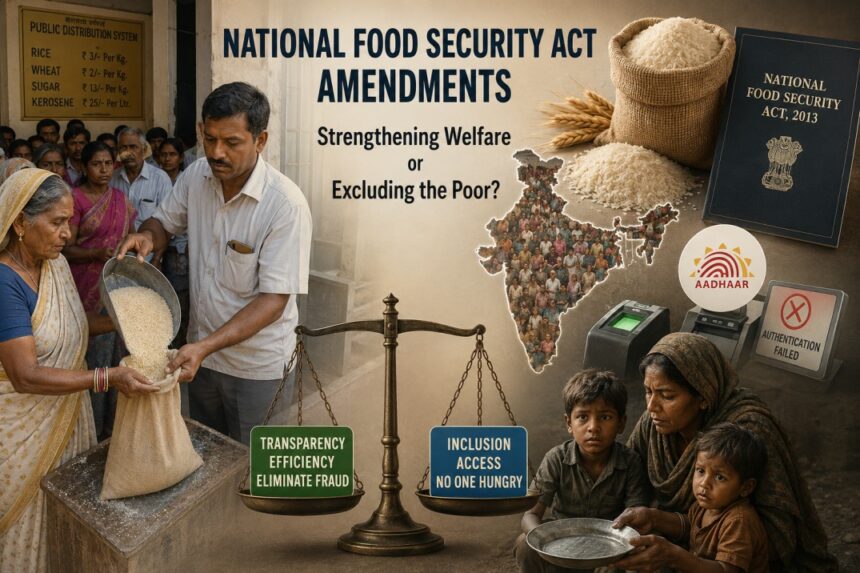
The Union Government’s proposed amendments to the National Food Security Act (NFSA), 2013 have triggered a nationwide political debate. The Centre argues that the reforms are intended to enhance transparency, eliminate fake ration cards, and ensure that government subsidies reach only genuine beneficiaries. Opposition parties and several state governments, however, fear that the changes could deprive millions of poor families of their legally guaranteed food security.
Viewed from the perspective of India’s poor rather than through a political lens, one fundamental question emerges: Will these amendments genuinely strengthen social welfare, or will they inadvertently push vulnerable families out of the welfare system?
A Lifeline for Millions
Enacted in 2013, the National Food Security Act is one of the world’s largest social welfare programmes. Today, it provides subsidised rice, wheat and other food grains to more than 800 million people across India.
For agricultural labourers, urban poor, migrant workers, senior citizens, widows, landless labourers and countless economically vulnerable families, the Act is far more than a government scheme—it is a vital safeguard against hunger and food insecurity.

Why Does the Centre Want to Amend the Law?
According to the Union Government, welfare programmes must evolve with changing times. By integrating Aadhaar, biometric authentication and digital technologies, the government believes it can eliminate fake beneficiaries, curb leakages, and prevent misuse of subsidies.
The savings generated from removing ineligible beneficiaries, the Centre argues, can then be redirected towards improving welfare measures for genuinely deserving families.
From an administrative standpoint, these objectives are both logical and desirable. Public funds should reach those who truly need them.

Why Are Opposition Parties Concerned?
The principal concern raised by opposition parties is that, in the process of eliminating fraudulent beneficiaries, genuine poor families may also lose access to food security.
Across India, many elderly citizens struggle with biometric authentication because fingerprints often fail to match. Internet connectivity remains unreliable in many tribal and remote regions. Migrant workers frequently change their places of residence. Homeless people and the extremely poor often lack the documentation required for verification.
If technological failures or documentation issues result in a family being denied ration benefits, the consequences extend far beyond administrative inconvenience. For many households, it could mean losing access to their primary source of food.

The Continuing Reliance on the 2011 Census
Perhaps the most critical issue in this debate concerns beneficiary coverage.
The number of beneficiaries under the National Food Security Act continues to be largely based on the 2011 Census. During the last fifteen years, India’s population has grown substantially. Millions of new families have been formed, while economic distress—particularly following the COVID-19 pandemic and other economic challenges—has pushed many households into poverty.
Several economists argue that the priority should be to include newly eligible poor families before removing existing beneficiaries. With millions of deserving households still excluded from the system, focusing solely on deletion without expanding coverage raises important questions about equity and social justice.
Why Is Tamil Nadu Strongly Opposing the Amendments?
Tamil Nadu has long been recognised as one of India’s most successful states in implementing the Public Distribution System (PDS). The state follows a near-universal ration distribution model and considers food security a fundamental social entitlement rather than merely a targeted welfare programme.
The state government fears that the proposed amendments could reduce the flexibility available to states in designing and implementing welfare programmes suited to their own socio-economic conditions. It is concerned that greater centralisation may weaken state-specific initiatives that have historically benefited vulnerable communities.
Why Did Vijay Write to the Prime Minister?
Actor-turned-politician and Tamilaga Vettri Kazhagam (TVK) president Vijay recently wrote to Prime Minister Narendra Modi urging the Centre not to introduce amendments that could weaken the National Food Security Act.
Vijay argued that food security is a basic social right and that no poor citizen should lose access to subsidised food because of Aadhaar-related issues, biometric failures or documentation problems. He also appealed to the Union Government to consult state governments thoroughly before introducing any significant legislative changes.
Both Sides Raise Legitimate Concerns
The debate is not entirely one-sided. The Union Government is justified in seeking to eliminate fake ration cards, reduce corruption and ensure efficient utilisation of taxpayer money. Public welfare programmes must maintain accountability and prevent misuse.
At the same time, the concerns raised by opposition parties deserve equal consideration. Even a single genuinely poor family should not lose food security because of technological limitations or bureaucratic errors. Hunger is not a technical issue—it is a humanitarian issue.
What Should Be the Way Forward?
If the objective is truly to protect India’s poor, any amendment to the National Food Security Act should be guided by five fundamental principles.
First, beneficiaries whose Aadhaar or biometric authentication fails should have a legally guaranteed alternative mechanism to receive their food entitlements. Second, beneficiary coverage should be revised using updated population data rather than relying indefinitely on the 2011 Census.
Third, state governments should retain sufficient flexibility to implement additional food security programmes according to their local needs. Fourth, technology should function as an enabler of welfare—not as a barrier to accessing it.
Finally, an effective and time-bound grievance redressal system should be established so that families wrongly excluded from the system can have their benefits restored without delay.
Beyond Politics
The debate surrounding the National Food Security Act should not be reduced to a political contest between the ruling party and the opposition. At its core, it concerns the food security and dignity of hundreds of millions of Indians. Removing fraudulent beneficiaries represents good governance. Including newly impoverished and deserving families represents social justice.
A truly successful reform must achieve both objectives simultaneously.
Ultimately, the success of these amendments should not be measured by the number of ration cards cancelled, but by a far more meaningful question: Has the government ensured that no poor Indian goes to bed hungry? That alone would reflect genuine public welfare—and fulfil the constitutional promise of social justice.