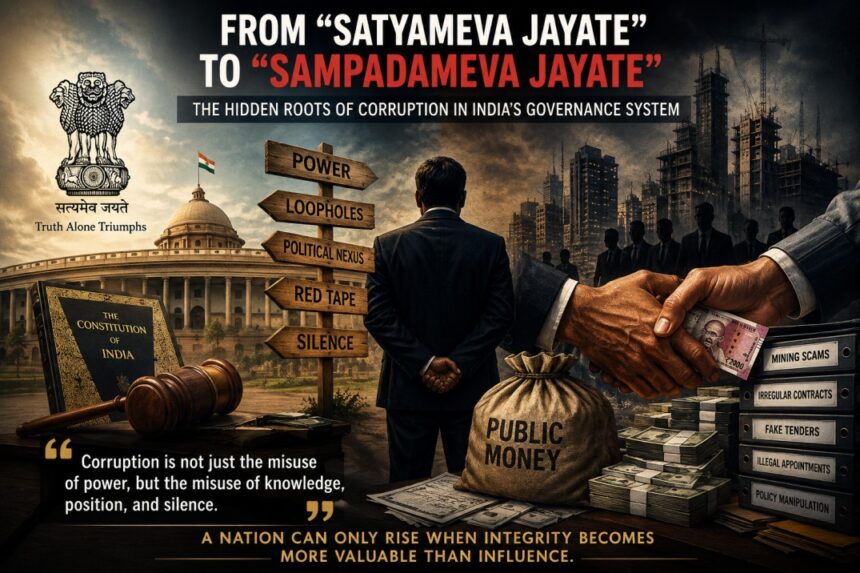
From “Satyameva Jayate” to “Sampadameva Jayate”:
Ch. V. Prabhakar Rao, Senior Journalist, 9391533339
When Dharma Gives Way to Power : “Satyameva Jayate Nanritam”—Truth alone triumphs, not falsehood. This timeless declaration from the Mundaka Upanishad has guided Indian civilization for millennia. “Dharmo Rakshati Rakshitah”—Dharma protects those who protect it. Yet, in contemporary India, these ideals appear increasingly distant from public life. The belief that truth ultimately prevails is gradually being replaced by the perception that wealth, influence, and connections determine success.
Whenever corruption is discussed, politicians become the primary targets of public criticism. Electoral bribery, illegal land deals, mining scandals, and the misuse of public funds are routinely attributed to elected leaders. While such criticism is often justified, it raises a deeper question: Are politicians alone responsible for corruption, or does the problem run much deeper within the machinery of governance?

A nation is not governed by politicians alone. Behind every minister stands a permanent bureaucracy that possesses institutional memory, technical expertise, and administrative authority. Governments change every few years, but the administrative apparatus remains. Policies may be announced by politicians, but they are designed, interpreted, and implemented by officials. Therefore, any meaningful discussion on corruption must examine the role of the bureaucracy alongside political leadership.

India’s civil services attract some of the brightest minds in the country. Thousands of young men and women dedicate years of their lives to preparing for examinations such as the UPSC. Many enter public service with ideals of nation-building and social transformation. Yet, over time, some become part of the very system they once hoped to reform. This raises an uncomfortable but necessary question: Why do highly educated and capable individuals sometimes become facilitators of corruption rather than guardians of public interest?
Kautilya, in the Arthashastra, warned that detecting corruption among officials is as difficult as determining whether a fish swimming in water is drinking it. More than two thousand years later, his observation remains strikingly relevant. Modern corruption is rarely visible. It hides within policy frameworks, administrative approvals, tender conditions, regulatory exemptions, and legal loopholes. The most dangerous form of corruption is not the violation of law but the manipulation of law.
The Crisis of Accountability and Moral Decline

It would be unfair to suggest that all public officials are corrupt. India has produced countless honest and dedicated civil servants who have worked tirelessly for public welfare. However, the larger concern is whether institutions reward integrity or accommodation, courage or compliance, public service or personal advancement.
The problem extends beyond politics and bureaucracy. It reflects a broader moral crisis within society itself. Honesty was once regarded as a virtue worthy of admiration. Today, wealth often commands greater respect than character. Society increasingly judges success by the amount of money accumulated rather than the means through which it was earned. This cultural shift creates an environment where corruption is tolerated, rationalised, and sometimes even celebrated.
Dr. B. R. Ambedkar warned that even the best Constitution could fail if administered by people lacking integrity. Conversely, imperfect institutions can function effectively when guided by ethical leadership. Laws alone cannot eliminate corruption. The true strength of a democracy lies in the character and accountability of those entrusted with power.
Corruption is not merely an economic crime. Every fraudulent contract diverts resources from public welfare. Every manipulated recruitment process destroys opportunities for deserving candidates. Every act of corruption deepens inequality and weakens public trust in institutions. Its victims are often the poorest and most vulnerable citizens.
Meaningful reform requires more than electoral change. Administrative transparency must be strengthened. Decision-making processes must be made more open to public scrutiny. Accountability mechanisms must extend not only to politicians but also to those who exercise administrative authority. Most importantly, governance must be guided by constitutional morality, ethical responsibility, and a renewed commitment to public service.
A Choice Before the Nation

The central question is not whether politicians or bureaucrats are solely responsible for corruption. The deeper challenge lies in a culture that normalises unethical conduct and glorifies wealth regardless of its source. As long as society values material success above integrity, corruption will continue to evolve and survive.
India does not suffer from a shortage of talent or intelligence. What it increasingly lacks is moral courage—the courage to uphold principles in the face of pressure, temptation, and personal gain. The future of Indian democracy depends not merely on stronger laws or new political slogans but on restoring the foundational values that shaped Indian civilization: Truth, Dharma, Accountability, and Public Duty.
Only then will Satyameva Jayate cease to be merely an inscription beneath the national emblem and once again become the living spirit of the Republic of India.
“A nation does not decline when it lacks wealth; it declines when it loses the courage to distinguish between power and righteousness.”
—————————-