

A Scientific, Economic and Policy Assessment of India’s Ethanol Blending Programme
India’s Ethanol Blended Petrol (EBP) Programme has been projected as one of the country’s most ambitious energy transition initiatives. The government argues that blending ethanol with petrol will reduce crude oil imports, lower greenhouse gas emissions, improve farmers’ incomes, strengthen energy security, and promote rural industrialization. These objectives are both understandable and strategically important for a country that imports nearly 85% of its crude oil requirements.
However, the success of any energy policy should not be judged solely by its intentions. It must also be evaluated on scientific evidence, economic efficiency, environmental sustainability, and long-term national interest. As India accelerates towards a 20% ethanol blending target, several critical questions deserve a serious public debate. Does ethanol actually provide a meaningful net energy gain? Does it conserve or consume scarce natural resources? Does it improve environmental sustainability, or merely shift pollution from one sector to another? Most importantly, is India’s ethanol policy being driven by sound economics or by the political influence of powerful agricultural and industrial lobbies?
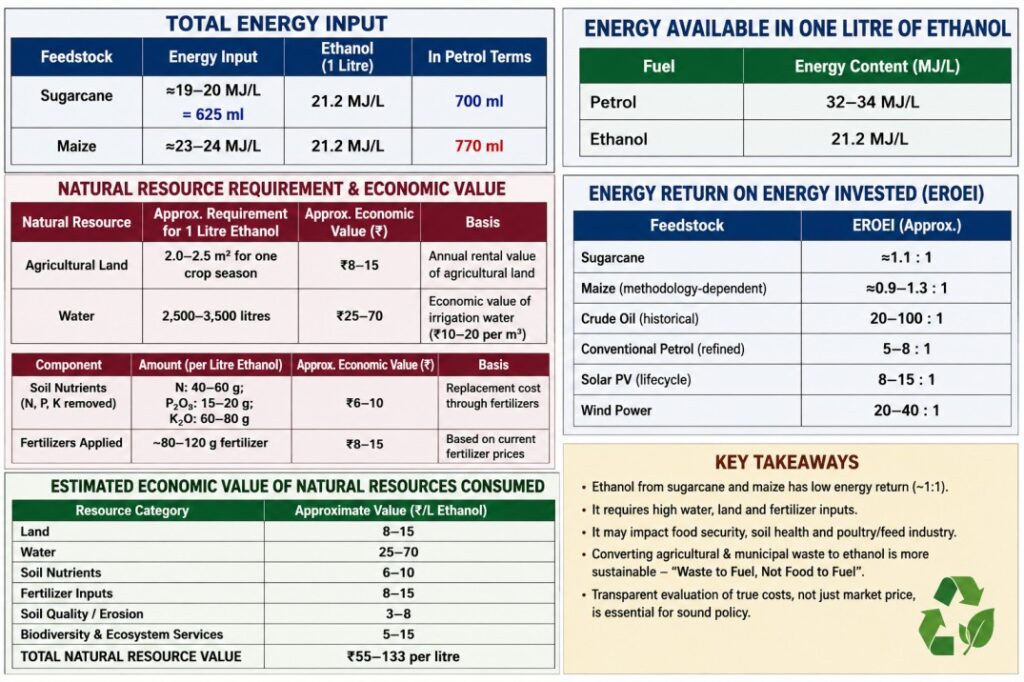
The figures presented in the accompanying data highlight several concerns. While some estimates—such as Energy Return on Energy Invested (EROEI) and production costs—vary across studies and methodologies, they nevertheless point towards issues that merit transparent, independent evaluation rather than unquestioned acceptance.
India’s Ethanol Mission

India initially promoted ethanol by utilizing molasses, a by-product of sugar production that would otherwise have limited commercial value. In that form, ethanol represented an efficient use of an existing industrial waste stream.
Over time, however, the policy evolved. Today, increasing quantities of ethanol are produced directly from sugarcane juice, sugar syrup, and maize. This marks a significant shift—from converting waste into fuel to cultivating food crops specifically for fuel production.
That distinction is fundamental. Using waste products improves resource efficiency. Growing dedicated crops for fuel fundamentally changes the economics, environmental footprint, and food security implications of the programme.


Does Ethanol Produce More Energy Than It Consumes?
One of the most debated aspects of ethanol production is its Energy Return on Energy Invested (EROEI)—the amount of usable energy produced relative to the total energy consumed during cultivation, irrigation, fertilizer production, harvesting, transportation, and distillation.
According to the estimates shown in research presentation:
| Feedstock | Approximate EROEI |
| Sugarcane Ethanol | ~1.1 : 1 |
| Maize Ethanol | ~0.9–1.3 : 1 |
| Conventional Petrol | 5–8 : 1 |
| Solar PV | 8–15 : 1 |
| Wind Energy | 20–40 : 1 |
If these estimates reflect Indian production conditions, ethanol provides only a marginal net energy gain. An EROEI close to one implies that nearly as much energy is consumed in producing the fuel as the fuel ultimately delivers.
It should be acknowledged that published EROEI values differ depending on assumptions, agricultural practices, and whether by-products such as bagasse are included in the calculations. Nevertheless, the broader question remains: How much net energy is India actually gaining after accounting for the entire production chain? This deserves transparent, peer-reviewed assessment rather than policy assumptions.
Water: India’s Most Precious Resource

Perhaps the greatest concern regarding India’s ethanol expansion is its enormous water footprint.
The data indicates that producing one litre of ethanol may require approximately 2,500 to 3,500 litres of water, considering both cultivation and processing.
Among India’s major agricultural crops, sugarcane is one of the most water-intensive. It requires substantially more irrigation than cereals, pulses, or oilseeds. This becomes particularly significant because India is already a water-stressed country.
Several states—including Maharashtra, Karnataka, Telangana, Andhra Pradesh, Tamil Nadu and Rajasthan—regularly face groundwater depletion, recurring droughts, declining reservoir levels and irrigation shortages. Southern India, in particular, has witnessed frequent interstate river-water disputes as competing demands outstrip available resources.
Promoting a fuel policy that depends heavily on one of India’s thirstiest crops raises an unavoidable policy question: Should scarce freshwater be used primarily to produce food or fuel?
Water security is as important to India’s future as energy security. Any energy transition that accelerates groundwater depletion cannot be considered fully sustainable.
Food versus Fuel
India possesses limited cultivable land and must simultaneously ensure food security for more than 1.4 billion people.
When agricultural land is increasingly devoted to fuel crops, less land remains available for producing food grains, pulses, edible oils and fodder. India already imports large quantities of edible oils, making domestic agricultural priorities even more critical.
The shift from waste-based ethanol to crop-based ethanol therefore revives the global “Food versus Fuel” debate. Producing renewable fuel is desirable, but not if it comes at the cost of agricultural resilience and long-term food security.
Impact on the Poultry and Livestock Industry
The increasing use of maize for ethanol production has implications beyond fuel policy.
Maize is one of the primary ingredients in poultry feed and is also widely used in dairy and livestock industries. If growing quantities of maize are diverted toward ethanol production, feed manufacturers must compete directly with distilleries for the same raw material.
Higher maize prices inevitably increase production costs for poultry farmers, dairy operators and feed manufacturers. These higher costs are eventually reflected in consumer prices for eggs, chicken and other protein-rich foods.
In the long run, if domestic production cannot satisfy both feed and fuel demand, India may increasingly depend on imported maize. The United States, one of the world’s largest maize exporters, could become a major supplier. While imports may temporarily stabilize supplies, they could also expose Indian farmers to volatile international markets and greater competition. A policy designed to strengthen domestic agriculture should not inadvertently create new import dependencies.
Soil Fertility and Agricultural Sustainability
Intensive cultivation of sugarcane and maize also affects soil health.
Continuous monocropping removes significant quantities of nitrogen, phosphorus and potassium from the soil. Replenishing these nutrients requires increasing fertilizer application, raising both production costs and environmental risks.
The presentation estimates substantial nutrient removal and fertilizer requirements per litre of ethanol produced. While the exact figures may vary, the underlying concern remains valid: expanding ethanol production through intensive cultivation may accelerate soil nutrient depletion, reduce biodiversity, increase soil erosion and weaken long-term agricultural productivity unless accompanied by sustainable farming practices.
Is Ethanol Really Cost-Effective?
Supporters often compare ethanol’s selling price with petrol. However, the true economic cost extends well beyond the refinery gate.
The actual cost includes:
- irrigation subsidies,
- electricity subsidies,
- fertilizer support,
- soft loans,
- transport,
- blending infrastructure,
- environmental degradation,
- land use,
- water consumption.
The presentation estimates that the economic value of natural resources consumed may range between ₹55 and ₹133 per litre of ethanol, excluding several indirect costs.
Critics argue that once these hidden costs and government incentives are included, ethanol becomes significantly more expensive than its market price suggests. Although estimates differ across studies, the essential point remains that market price alone does not reflect the true social cost of ethanol production.
Waste to Fuel, Not Food to Fuel
Perhaps the most important policy question is not whether India should produce ethanol—but how it should produce ethanol.
Globally, research is increasingly focused on second-generation (2G) and advanced biofuels produced from agricultural residues, crop waste, forestry biomass, municipal solid waste and other organic materials that would otherwise be discarded.
This approach offers several advantages:
- No competition with food production.
- No additional agricultural land.
- Lower freshwater demand.
- Better waste management.
- Improved environmental sustainability.
Using crop residues such as paddy straw, corn stover and sugarcane bagasse converts waste into valuable energy while reducing stubble burning and pollution.
By contrast, cultivating additional sugarcane and maize specifically to manufacture ethanol imposes heavy demands on land, water, fertilizers and electricity. From a resource management perspective, converting existing waste into fuel is considerably more sustainable than producing new crops solely for energy.
India’s long-term biofuel strategy should therefore evolve from “Food to Fuel” towards “Waste to Fuel.”
International Experience
It would be inaccurate to suggest that developed countries have abandoned ethanol altogether.
Brazil continues to rely heavily on sugarcane ethanol, while the United States remains the world’s largest producer of corn ethanol.
However, an important trend is evident. Many developed economies are gradually shifting their focus towards:
- advanced biofuels,
- electric mobility,
- hydrogen,
- sustainable aviation fuels,
- waste-based bioenergy.
The emphasis is increasingly on technologies that minimize competition with food production and reduce overall environmental impacts.
Is There a Political Economy Behind Ethanol?
Large public policies inevitably create economic winners and losers.
India’s ethanol programme provides significant benefits to:
- sugar mills,
- distilleries,
- maize processors,
- fertilizer manufacturers,
- irrigation equipment suppliers,
- agricultural credit institutions,
- transport and logistics industries.
These sectors collectively represent substantial economic and political influence.
Recognizing these interests does not imply wrongdoing. However, it underscores the need for transparent policymaking. Public policy should be guided by independent scientific evidence and comprehensive cost-benefit analyses rather than the preferences of any particular industry.
Greater transparency regarding subsidies, environmental costs and life-cycle economics would help strengthen public confidence in the programme.
The Way Forward
India undoubtedly requires greater energy security. Reducing crude oil imports is a legitimate national objective. However, energy security should not come at the expense of water security, food security or ecological sustainability.
A balanced ethanol policy should therefore:
- Prioritize second-generation ethanol from agricultural residues, forestry biomass and municipal waste.
- Restrict expansion of water-intensive feedstocks in drought-prone regions.
- Protect maize availability for poultry and livestock industries.
- Conduct transparent life-cycle assessments covering energy balance, water use and environmental costs.
- Encourage crop diversification instead of excessive dependence on sugarcane.
- Gradually reduce dependence on subsidies and allow technology-driven efficiency to determine competitiveness.
- Integrate ethanol with a broader clean-energy strategy that includes electric mobility, green hydrogen, renewable electricity and sustainable public transport.
Conclusion
India’s ethanol programme represents both an opportunity and a challenge. It has the potential to reduce crude oil imports, diversify energy sources and provide additional markets for farmers. At the same time, it raises equally important concerns regarding water consumption, land use, soil degradation, fertilizer dependence, food security and economic efficiency.
The evidence suggests that the future of biofuels should not lie in expanding the cultivation of water-intensive crops such as sugarcane and maize solely for fuel production. Instead, India’s comparative advantage lies in converting the enormous quantities of agricultural residues, crop waste and municipal organic waste generated every year into clean energy. Such a strategy would reduce pollution, improve waste management and minimize competition with food production while conserving precious land and water resources.
The central issue is therefore not whether ethanol is good or bad. The real question is whether India’s ethanol policy is optimizing the use of its scarce natural resources. A sustainable energy transition must be based on full life-cycle economics, transparent scientific evaluation and long-term national interest—not merely on blending targets or the commercial interests of powerful stakeholders.
If India embraces a “Waste to Fuel” model instead of a “Food to Fuel” approach, ethanol can remain an important component of the country’s energy mix without compromising agricultural sustainability, water security or food availability. That would represent a genuinely green transition—one that serves both the economy and future generations.