

Chennai, August 13:
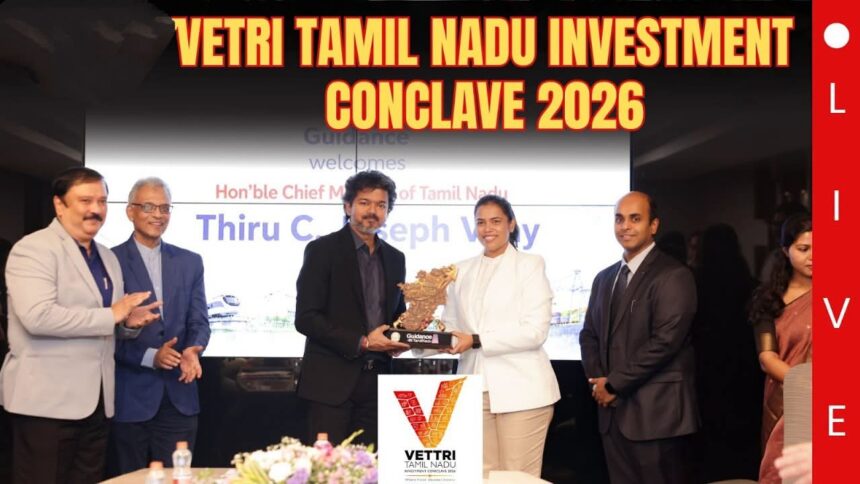
The Tamilaga Vettri Kazhagam (TVK) government has placed an ambitious economic vision at the centre of its “Vettri Tamil Nadu” programme, setting a target of transforming Tamil Nadu into a $1.5 trillion economy by 2036.
The programme seeks to combine industrial expansion, investment promotion, artificial intelligence, MSME development, employment generation and improved public-service delivery to accelerate the state’s economic growth. The long-term target is also incorporated into the TVK’s policy framework and economic roadmap.
Vision for a New Tamil Nadu

“Vettri Tamil Nadu” is being presented as a broad development vision rather than merely an investment campaign. The programme invites citizens to contribute their ideas and aspirations for the state and its constituencies, with the objective of building a development agenda around employment, prosperity and inclusive growth.
The government’s economic strategy places particular emphasis on attracting domestic and international investment, strengthening manufacturing, promoting emerging technologies and creating employment opportunities closer to people’s homes.
$1.5 Trillion Economy by 2036

The most significant economic ambition is the target of achieving a $1.5 trillion state economy by 2036. According to the TVK’s policy document, the target is intended to be supported by a proposed White Paper on state finances, an expanded MSME ecosystem, artificial intelligence-led development and a major clean-energy push.
The policy framework proposes a ₹15,000 crore MSME guarantee fund, intended to improve access to finance for small and medium enterprises. MSMEs are expected to play a crucial role in generating employment, encouraging entrepreneurship and spreading industrial development beyond the major urban centres.
Focus on AI and Emerging Industries
Artificial intelligence is another major pillar of the programme. The TVK’s policy framework proposes India’s first dedicated Ministry of Artificial Intelligence, along with an AI City and AI universities aimed at developing talent and attracting technology companies and research institutions.
The government also sees sectors such as semiconductors, electric vehicles, advanced manufacturing and technology services as potential engines of future economic expansion. The broader objective is to move Tamil Nadu further up the value chain instead of relying primarily on conventional manufacturing.
Investment and Employment

Investment promotion is being linked directly to job creation. The government’s vision stresses the need to create employment opportunities within Tamil Nadu and reduce the need for young people to migrate in search of work.
The programme proposes an investor-friendly administrative framework and faster clearances to reduce delays in establishing industrial units. The government’s policy agenda also includes a proposed Tamil Nadu Investor Promotion Commission and a new industrial policy.
Decentralised Industrial Development
A major challenge for Tamil Nadu’s economic expansion will be ensuring that investment does not remain concentrated around Chennai and a few established industrial corridors.
The TVK’s economic vision therefore envisages decentralised industrialisation, with greater opportunities for districts and smaller cities. This approach is intended to connect industrial growth with local employment, infrastructure development and MSME expansion. The party’s policy framework specifically identifies decentralised industrialisation as one of the routes towards the $1.5 trillion target.
Welfare Alongside Growth
The “Vettri Tamil Nadu” vision is not restricted to economic growth. The government’s broader policy blueprint combines economic expansion with welfare measures covering women, education, healthcare, agriculture, electricity, basic amenities and employment.
Its 10-guarantee framework contains 40 policy points covering areas such as women’s welfare, health, education, jobs, agriculture, infrastructure, social harmony, clean governance, future-oriented development and women’s safety.
The women’s welfare component, for example, proposes monthly income support for eligible women heads of households, along with measures concerning cooking fuel and mobility.
Governance Reforms
The economic programme also argues that investment and development require a more efficient administration. The TVK framework proposes greater use of artificial intelligence and digital systems for government services, including a Citizen Privilege Card and doorstep delivery of public services.
The stated objective is to reduce bureaucratic delays and make government services more accessible while improving transparency.
Clean Energy as an Economic Driver
Energy security is another important component of the long-term economic strategy. The TVK policy framework proposes a target of 50% clean power by 2030.
The emphasis on renewable energy is intended not only to address environmental concerns but also to support industrial competitiveness. Reliable and increasingly clean electricity will be important for sectors such as electric vehicles, electronics, data centres, semiconductor manufacturing and AI infrastructure.
Vision Document and Government Programmes
The economic agenda forms part of a larger “Vettri Thamizhagam” vision document approved by the TVK-led government. The document reportedly contains 436 schemes across 32 government departments, with departments instructed to formulate detailed project reports and implementation targets.
The approach indicates an attempt to link the government’s long-term political vision with department-wise programmes and measurable implementation goals.
The Road Ahead
Achieving a $1.5 trillion economy will require sustained growth over a decade, substantial private investment, infrastructure expansion, higher productivity and a large increase in employment opportunities. It will also require careful management of public finances so that welfare commitments and capital investment remain sustainable.
The success of the “Vettri Tamil Nadu” programme will ultimately depend not merely on announcing ambitious targets but on converting them into actual investments, factories, startups, jobs, exports and higher household incomes.
For Tamil Nadu, the $1.5 trillion target therefore represents both an economic ambition and a test of the new government’s ability to combine growth, technology, industrialisation, employment, welfare and fiscal discipline into a coherent long-term development strategy.
Source: TVK policy and programme documents; reports on the “Vettri Thamizhagam” vision and Tamil Nadu’s economic policy.