

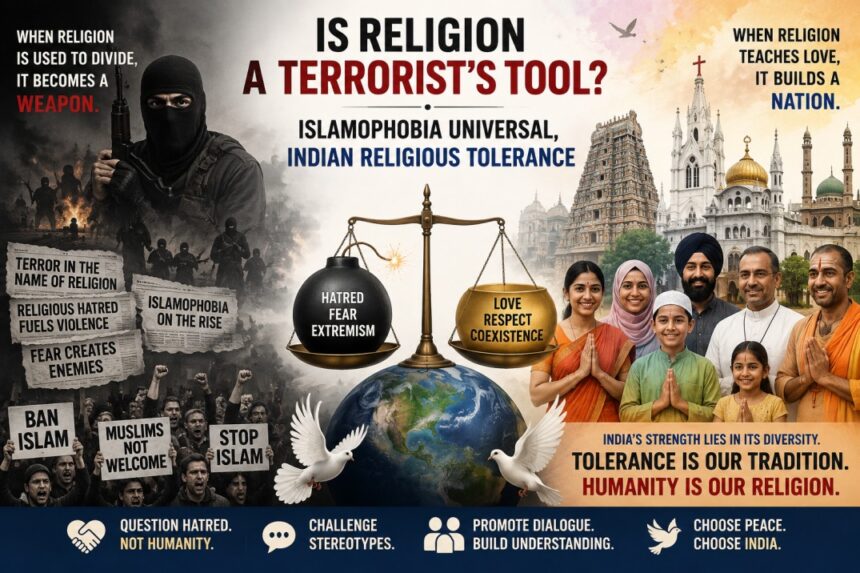
— But the Political Lens Through Which Religion Is Viewed
Islam, Political Opposition and Extremism: Where Do the Obstacles to Coexistence Lie?
Politics in the Name of Religion… Religious Polarisation in the Name of Politics… and Coexistence Caught in Between
— Ch. V. Prabhakar Rao, Senior Journalist, 939153333
In India, opposition to Islam is not merely the result of religious differences of opinion; it is widely understood that politically motivated factors have played a significant role. Memories of Partition, religious politics, allegations of vote-bank politics, terrorist attacks, border security concerns, suspicions surrounding population and migration, and the rise of Hindutva politics have all influenced this opposition.
Some political forces have used Islam and Muslim identity as a political counter-identity in their electoral and political mobilisation. On the other hand, certain religious or political sections within the Muslim community have also politically reinforced their separate identity. As a result, political identity, rather than religion itself, has increasingly become a source of suspicion in Hindu-Muslim relations.
Not All Muslims Are Terrorists — Why Do We Fail to Recognise This Truth?
One of the most dangerous aspects of the growing suspicion toward Islam around the world is the tendency to equate Muslim religious identity with terrorism.
Organisations such as Al-Qaeda and ISIS have used the name of Islam, but their ideology does not represent the hundreds of millions of ordinary Muslims across the world. A Pew Research Center survey conducted earlier across 39 countries found that large sections of Muslim populations rejected suicide attacks against civilians and the justification of violence in the name of defending Islam. Therefore, the equation “Muslim equals terrorist” is contrary to reality.
More Read

However, there is another side to this issue.
Terrorist organisations operating in the name of Islam have caused enormous damage to Muslims themselves across the world. Their actions have damaged the image of an entire religion and contributed to suspicion and prejudice against ordinary Muslims.
Why Is There Political Opposition to Islam in India?
To understand Hindu-Muslim relations in India, one must consider the Partition of 1947, the violence that accompanied it, the historical trauma associated with the creation of Pakistan, and the numerous communal conflicts that followed.

Even after Independence, some political parties have used religious identities in electoral politics. On the one hand, there have been allegations of political mobilisation around minority votes. On the other, Hindutva politics, which seeks to transform majority religious identity into a political force, has grown stronger.
Here, an important distinction must be made.
Hinduism and Hindutva as a political ideology are not the same thing. Similarly, Islam and Islamism are not the same.
Religion is a system of spiritual belief, whereas an ideology that seeks to use religion as an instrument for political power is a different matter. Failure to recognise this distinction has contributed to a situation in which religion and politics continually accuse each other.
A Pew Research Center survey conducted in 2019–20 among nearly 30,000 Indians found that the tendency to link Hindu identity with Indian national identity was strong among certain sections. Around 64% of Hindus said that being Hindu was very important to being “truly Indian.” At the same time, 84% of Indians said that respecting all religions was very important to being truly Indian.
This data suggests that Hindu national identity and religious coexistence can both remain strong in India at the same time.

How Valid Is the Argument That “Muslims Are Foreigners”?
Portraying Muslims in India as “foreigners” is problematic both historically and constitutionally.
The overwhelming majority of Indian Muslims belong to families that have lived on this land for centuries. Their languages, food, music, literature, architecture, Sufi traditions and regional cultures have all become integral parts of Indian civilisation.
Therefore, just as it is wrong to view an Indian Muslim as a foreigner merely because of his or her religion, it is equally problematic to regard India as a country belonging exclusively to one religion.
The Indian Constitution does not determine a citizen’s rights based on religion.
It Is Time for the Muslim Community to Look Within as Well
It is as wrong to dismiss all opposition to Islam around the world as Islamophobia as it is to view every Muslim with suspicion of terrorism.
At the same time, wherever there are ideologies that justify violence in the name of Islam, religious intolerance, hateful statements against other religions, the tendency to respond to criticism of religion with violence, or opposition to equal rights for women, Muslim religious leadership must speak openly against them.
Mosques, madrasas, religious institutions and social organisations should strongly promote constitutional values, scientific thinking, respect for other religions, gender equality and an unequivocal rejection of violence among young people.
At the same time, it is equally wrong to label every traditional practice among Muslims as “extremism.” Wearing religious clothing, offering namaz, visiting a mosque or consuming halal food are not indicators of terrorism.
Respecting religious freedom and combating extremism are both possible at the same time.
The Line Between Religion and Politics Must Be Clear
One of the major problems in India is the use of religious emotions by political parties for electoral mobilisation. This is not a problem confined to any one religion.
When religion is used as a political weapon, stronger religious politics often emerge within other communities in response.
When one group says, “Our religion is in danger,” another group begins mobilising by saying, “Our religion is also in danger.”
That is why the change India needs is not limited to the Muslim community alone. Hindu, Muslim, Christian, Sikh and Buddhist communities—all religious communities—must ensure that their faith is not used as a weapon of political hatred.
The Question of Double Standards in the US and the West
The foreign policy of the United States and Western countries also cannot be excluded from any discussion on Islam and terrorism.
From the Cold War era to Afghanistan, the United States has a history of maintaining relationships with various armed and political forces in pursuit of geopolitical interests. There have also been instances where a force that was once viewed as a strategic ally later became an adversary.
This offers an important lesson:
The world’s major powers must follow consistent standards in confronting terrorism.
When an armed group is described as a “resistance force” when it serves strategic interests, but the same group is labelled a “terrorist organisation” after it becomes an adversary, it raises serious questions about international ethics and credibility.
Why Should Muslims Speak Out More Openly?
Religious leaders must speak about peace, coexistence and human dignity even before political leaders do.
A Muslim young person should see a person belonging to another religion not as an enemy but as a fellow citizen. Similarly, a Hindu young person should see a Muslim not as a foreigner but as a fellow Indian citizen.
Even though religious divisions remain strong in India, we should not forget that a large majority of Indians consider respect for all religions to be an important part of Indian identity.
Equality and Fraternity Among Citizens Are Essential
Hindu society, particularly forces representing Hindutva politics, must also ask itself an important question:
Criticising Islam is one thing; portraying an Indian Muslim as a person alien to India is another.
The first may be part of democratic debate. The second can contribute to social division. India must ask itself whether such a division is really necessary.
Not all Hindus are anti-Muslim. But Hindu society must also question politics that promotes hatred in the name of religion.
The United States and Western countries, too, must follow consistent standards in dealing with terrorism. A double standard in which terrorism is opposed in one place while relationships are maintained with similar forces elsewhere for strategic interests undermines global trust.
What Needs to Change Is Not Religion — But the Political Lens Through Which Religion Is Viewed
Ultimately, what India needs is not victory for one religion over another, but equality among citizens under the Constitution.
A Muslim should be able to follow his faith while remaining fully Indian.
A Hindu should be able to follow his dharma while accepting a Muslim as an equal Indian citizen.
A Christian, Sikh, Buddhist or Jain should be able to live with the same rights and dignity.
Religion should remain a matter of personal faith; the Constitution should remain the common social contract for everyone.
Politics should bring religions together, not divide them.
Only then can the space for extremism shrink, while the space for Islamophobia also diminishes. Only then can India move from a society living in fear of religious differences towards a society where people of different faiths live together with mutual respect.
The answer is not to change religion. The answer is to change the political lens through which religion is viewed. ——–