

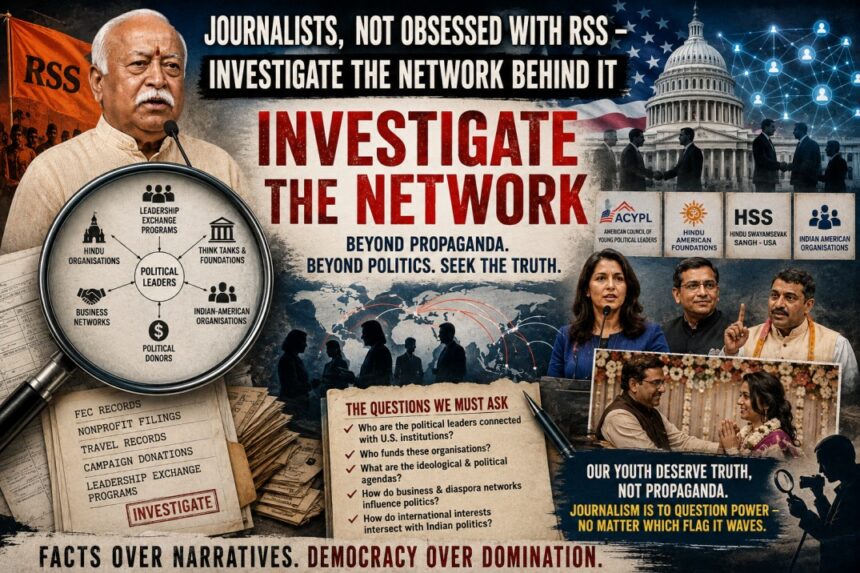
— Investigate the Network Behind the Power
Our duty is not to look toward America for answers, but to enlighten India’s youth with facts, evidence and courage
By Ch. V. Prabhakar Rao, Senior Journalist, 9391533339
The debate surrounding RSS chief Mohan Bhagwat’s visit to the United States exposes a disturbing weakness in Indian journalism. Some Indian liberals appear to be waiting for America to curb or act against the RSS. Others are portraying Bhagwat’s visit as being obstructed by American liberals. Still others seem to believe that his meetings in the United States could help the Modi government secure a favourable trade arrangement with the Trump administration.
But why should Indian journalism be so dependent on what Washington thinks about the RSS?
America is not the guardian of Indian democracy. Nor should American approval or disapproval become the measure of Indian nationalism, secularism or democracy.

The United States has its own strategic interests. China, Russia, the Indo-Pacific, defence cooperation, trade, technology and global geopolitical competition all influence Washington’s relationship with India. Therefore, Indian journalists should neither celebrate American criticism of the RSS as a victory for Indian democracy nor interpret American engagement with the Modi government as an endorsement of Indian democratic values.
Our responsibility is to investigate the networks of power ourselves.

One important area deserving serious examination is the history of political leadership exchanges between India and the United States, particularly programmes such as the American Council of Young Political Leaders (ACYPL).

In 1994, Narendra Modi and present Union Minister G. Kishan Reddy were among Indian political leaders who travelled to the United States under an ACYPL programme. Kishan Reddy’s own official biography records that he visited the United States for 45 days in July–August 1994 at the invitation of ACYPL and studied the American political system.
This fact does not prove that America “created” Indian political leaders or controlled their political careers. Such a claim would require substantial evidence. But it certainly raises questions worth investigating.
Who selected these young political leaders? Why were they selected? Who did they meet in the United States? What kind of political exposure and leadership training did they receive? What relationships were established? Did those relationships continue over the following decades? Did such programmes contribute to wider political networks between India and the United States?
A serious journalist does not begin with a conclusion. A serious journalist begins with questions.
The broader American engagement with Indian political leadership also deserves examination. As Washington increasingly viewed India as a strategic partner in the context of its competition with China and Russia, political, business, academic and diaspora networks between the two countries expanded.
Again, this does not automatically establish a conspiracy. But neither should journalists be so timid that they refuse to examine the possibility of long-term influence networks.

The same scrutiny must be applied to the RSS and its overseas ecosystem.
There are numerous Hindu-American and Indian-American organisations in the United States. Some have formal organisational structures; others are advocacy groups, cultural organisations, charities, political networks or community organisations. Some individuals associated with these organisations have openly expressed ideological sympathy with the RSS or the broader Sangh Parivar, while others may have no formal organisational connection.
That distinction matters.
Journalists must ask: Which organisation is formally connected to the RSS? Which merely shares its ideology? Who finances whom? What do nonprofit filings show? Who donates to political campaigns? Which businesspeople support particular candidates? Which organisations organise conferences and leadership programmes? What are their sources of funding?
The story is not simply about the RSS. The story is about networks of influence. The political rise of Tulsi Gabbard provides an important case study in this regard.
Investigations have documented the involvement of several Indian-American individuals in Gabbard’s early political support network. The Caravan, for example, reported on the role of Houston businessman Vijay Pallod, including his early financial support for Gabbard, and described Michael Brannon Parker as a person who helped connect Pallod with Gabbard. The same investigation discussed Mihir Meghani and Ramesh Bhutada, among others, in the context of Indian-American and Hindu-American networks supporting Gabbard. These relationships should be examined carefully through campaign-finance records and organisational documents rather than through political speculation.
The important question is not whether every donor was an “RSS man.” The important question is how these people were connected, what organisations they were associated with, where their money came from, and why they chose to support a particular American political figure.
That is where investigative journalism begins.
The connection between Gabbard and Indian political circles also became visible in her personal life. When Gabbard married in Hawaii in 2015 in a Hindu ceremony, BJP/RSS leader Ram Madhav attended and later wrote that he had carried Narendra Modi’s greetings and a gift for her.
One wedding attendance cannot prove political control. But when personal relationships, political networks, ideological organisations and financial support repeatedly intersect, journalists have every right—and arguably a responsibility—to examine the network.
The role of Chris Butler, whom Gabbard has described as a spiritual teacher, is another complicated part of the story. Gabbard grew up around Butler’s Science of Identity Foundation. She has rejected claims that Butler controlled her political decisions.
But The Washington Post’s investigation into thousands of pages of documents surrounding Gabbard’s congressional career has raised questions about the political advice and messaging she received. The newspaper compared 32 television interviews with language contained in mysterious political memos and reported that in 24 instances Gabbard used language that closely tracked those memos.
That deserves investigation.
But it does not justify casually calling Gabbard an “RSS spy.”
Journalism must distinguish between evidence, influence, association and accusation.
The work of journalist and activist Pieter Friedrich has also focused extensively on the American Sangh ecosystem and its alleged connections with Gabbard’s political support network. His work has raised questions about individuals such as Bhutada, Meghani, Pallod and others.
But Friedrich’s claims, like those of any activist or researcher, should be independently verified. A journalist’s job is not to reproduce an activist’s conclusions. It is to examine the underlying documents and establish what can actually be proved.
This is precisely where Indian journalism needs greater courage.
We have more than enough political shouting. What we lack is systematic investigation.
Instead of merely asking whether the RSS is good or bad, journalists should investigate its institutional structure, its relationship with the BJP, its affiliated organisations, its overseas activities, its funding networks and its ideological influence.
But the investigation cannot stop there.
Examine the RSS. Examine the BJP. Examine Congress. Examine corporate power. Examine foreign-policy networks. Examine diaspora organisations. Examine political donors. Examine think tanks. Examine international leadership programmes. Examine everyone who exercises influence.
And apply the same standard to all of them. The media should not become an extension of either the RSS or its opponents. It should not become a megaphone for American liberals.
It should not become a megaphone for American conservatives. It should not become a megaphone for Indian political parties.
Journalism must remain a watchdog—not a political campaign office. The most important questions are therefore simple:
Who meets whom? Who funds whom? Who introduces whom? Who trains whom? Who provides political access? Which relationships are official?
Which are personal? Which are ideological? Which are financial? And what documentary evidence exists?
These questions can take journalism beyond superficial headlines and social-media propaganda.
Our youth do not need another simplistic battle between “RSS supporters” and “RSS opponents.” They need to understand how political power operates, how money moves, how ideological organisations build networks, how diaspora communities influence politics and how international strategic interests intersect with domestic politics.
We should not expect Washington to defend Indian democracy. Nor should we assume that every American criticism of India is motivated by concern for Indian democracy.
America has interests. India has interests. Political organisations have interests. Corporations have interests. Diaspora organisations have interests. And journalists must investigate all of them. Therefore, my appeal to Indian journalists is simple:
Do not wait for America to expose India. Do not wait for an American liberal to challenge the RSS.
Do not wait for an American conservative to praise Indian nationalism. Do not turn foreign approval into national pride or foreign criticism into national shame. Look at India. Investigate India. Follow the money. Map the networks. Question power. Verify every allegation.
Do not become obsessed with the RSS. Become obsessed with the truth. If the RSS has influence, document it. If political parties have foreign networks, investigate them. If corporate interests influence politics, expose them.
If diaspora organisations finance political campaigns, follow the money. If international leadership programmes create lasting political relationships, investigate those relationships. But never replace evidence with propaganda.
Our young generation deserves something better than political slogans. They deserve facts. They deserve history. They deserve evidence.
They deserve the freedom to question every ideology and every power centre. Most importantly, they deserve journalists who are not afraid. India’s democracy will not be saved by Washington, New York or any foreign government.
It must ultimately be defended by an informed Indian citizenry. And an informed citizenry can exist only when journalists have the courage to tell the truth—even when that truth is uncomfortable for the powerful.
–