New Delhi June 08:
Are India’s current political developments pointing toward a major realignment of opposition politics? The discussions emerging after the recent INDIA alliance meeting in New Delhi suggest that such a possibility cannot be entirely ruled out.
Across the country, a growing section of opposition leaders believes that a united front is essential to effectively challenge the Bharatiya Janata Party (BJP). In this context, the special meeting between West Bengal Chief Minister Mamata Banerjee and Congress leader Rahul Gandhi has attracted significant political attention.
While there is no official indication that Mamata Banerjee is planning to rejoin the Congress Party, if such a development were to occur, it could become much more than a simple political homecoming. It could potentially reshape the contours of Indian politics.
Understanding BJP’s Political Strategy
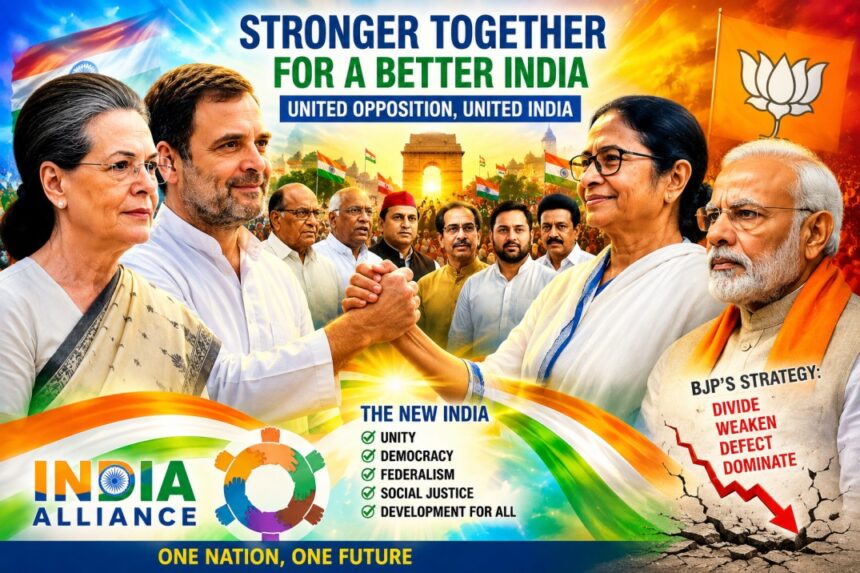
Over the past decade, one of BJP’s most successful political strategies has been to weaken opposition forces by isolating regional parties and fragmenting opposition unity.

Political developments in several states—including splits within Shiv Sena and NCP in Maharashtra, shifting alliances in Bihar, and defections in various states—have reinforced the perception among opposition leaders that regional parties often face enormous pressure when they operate in isolation.
As a result, many regional parties are increasingly confronting a difficult question: Can they effectively challenge BJP alone, or does the future lie in broader political consolidation?
Could Mamata’s Move Become a National Signal?
Mamata Banerjee is not an ordinary political figure. She ended the 34-year rule of the Left Front in West Bengal and built a powerful regional party after breaking away from Congress.

If a leader of her stature were to move closer to Congress again, it would send a strong political message across the country.
Such a decision could reinforce the idea that defeating a dominant national party may require opposition forces to set aside past differences and work under a broader national framework.
More importantly, it could encourage other regional leaders to rethink their long-term political strategies.
What If Other Regional Parties Follow?
This is where the implications become far more significant.
If major regional parties begin prioritizing national opposition unity over independent expansion, Indian politics could enter a new phase.
Parties such as the RJD in Bihar, Samajwadi Party in Uttar Pradesh, DMK in Tamil Nadu, and other regional forces may increasingly coordinate with Congress through seat-sharing arrangements, joint campaigns, common policy platforms, and coordinated parliamentary strategies.

Some parties may continue to retain their separate identities while working closely with Congress. Others could explore deeper institutional alliances in the future.
The central question would no longer be who leads individual states, but how opposition forces can collectively challenge BJP’s nationwide political machinery.
Could Congress Become the Central Pole Again?
Since 2014, Congress has experienced significant electoral setbacks. Yet it remains the only opposition party with a nationwide organizational presence.
If influential regional leaders begin moving closer to Congress, the party could regain its position as the central pole around which opposition politics revolves.
Such developments would not only strengthen Congress numerically but also psychologically. Opposition voters across the country could begin to view a united opposition as a credible alternative to BJP.
Political momentum often depends as much on perception as on numbers. A broad opposition coalition could alter both.
A New Political Landscape Before 2029?
If regional parties and Congress succeed in building a stable and cooperative framework, the political environment leading up to the 2029 general election could look dramatically different.
For years, BJP has benefited from a fragmented opposition. A consolidated opposition bloc could challenge that advantage.
However, opposition unity alone may not be enough. A successful alliance would also need to present a compelling vision for governance, economic development, federalism, social justice, and democratic institutions.
The battle would then shift from mere anti-BJP politics to a contest between competing visions for India’s future.
Conclusion
Whether Mamata Banerjee ever rejoins Congress remains entirely speculative. Yet the very discussion reflects the changing dynamics of Indian politics.
If leaders who once left Congress to establish powerful regional movements begin reconsidering broader national alignments, it could signal the beginning of a new political chapter.
A transition from fragmented opposition politics to a more organized and united opposition front would represent one of the most significant shifts in contemporary Indian politics.
Should such a transformation occur, the political map of India over the coming decade could look very different from what it does today.