

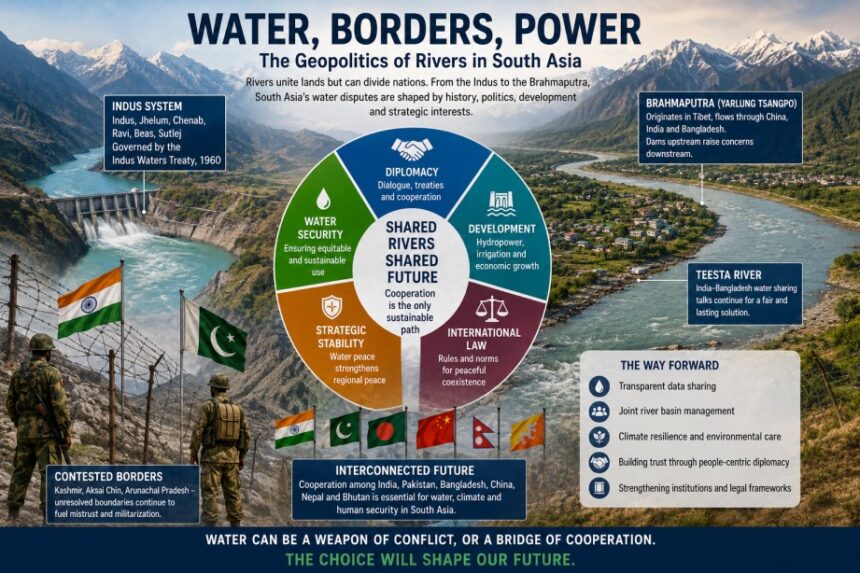
By Ch. V. Prabhakar Rao, Senior Journalist, 9391533339.
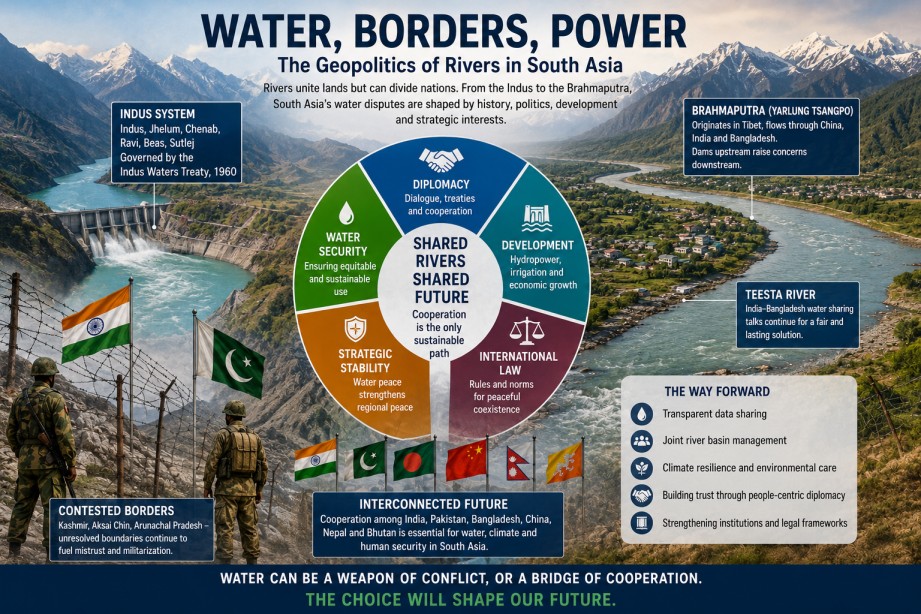
Water has emerged as one of the most strategic resources of the twenty-first century. In South Asia, rivers are not merely sources of drinking water and irrigation; they are instruments of national security, diplomacy, economic development, and geopolitical influence. The Indus, Brahmaputra, Ganges, Teesta, and their tributaries connect India with Pakistan, China, Bangladesh, Nepal, and Bhutan, making water governance inseparable from regional politics.
The roots of many of today’s water disputes can be traced back to the Partition of 1947. The Radcliffe Line divided territories but not river systems. While the headworks and control structures of several rivers remained within India, vast irrigated agricultural lands became part of Pakistan. This geographical imbalance immediately transformed water into a strategic issue.
The first major crisis emerged in 1948 when the temporary suspension of water flows through certain canal systems heightened Pakistani concerns over water security. Recognising that prolonged confrontation would threaten regional stability, both countries entered negotiations under the mediation of the World Bank. These efforts culminated in the Indus Waters Treaty (1960), signed by Prime Minister Jawaharlal Nehru and Pakistan’s President Ayub Khan.
The treaty allocated the eastern rivers—Ravi, Beas, and Sutlej—to India, while Pakistan received primary rights over the western rivers—Indus, Jhelum, and Chenab, subject to limited Indian usage for hydropower and certain agricultural purposes.
More than six decades later, the treaty continues to attract sharply different assessments. Supporters regard it as one of the world’s most durable international water-sharing agreements, having survived several wars and prolonged political hostility. Critics, however, argue that India made excessive long-term concessions over strategically important western rivers. Whether those decisions reflected diplomatic foresight or unnecessary generosity remains a subject of legitimate historical debate rather than settled fact. Any assessment must also consider the circumstances of the 1950s, when India was simultaneously dealing with nation-building, refugee rehabilitation, economic constraints, and Cold War pressures.

India’s strategic environment changed dramatically after the 1962 war with China. Beijing established control over Aksai Chin while continuing to dispute India’s sovereignty over Arunachal Pradesh. Since then, the unresolved boundary dispute has evolved into one of Asia’s most sensitive security challenges. Military infrastructure, border villages, roads, and logistics networks have steadily expanded on both sides of the Line of Actual Control, reflecting growing strategic competition.

China’s role extends beyond territorial disputes. As the upper riparian state for several major Asian rivers, including the Brahmaputra (Yarlung Tsangpo), it possesses significant influence over downstream water flows. The construction of dams and hydropower projects in Tibet has generated concerns in both India and Bangladesh regarding long-term ecological impacts, flood management, and water availability. Although China maintains that these projects are intended primarily for hydropower generation and flood control, downstream countries continue to seek greater transparency and institutional mechanisms for data sharing.
The geopolitical landscape shifted once again after the 1971 Bangladesh Liberation War. India’s decisive military victory resulted in the surrender of nearly 93,000 Pakistani prisoners of war—the largest such surrender since the Second World War. This unprecedented strategic advantage has prompted an enduring debate among historians and strategic analysts.
One school of thought argues that India could have used its military leverage to pursue stronger political concessions from Pakistan, including issues relating to Pakistan-occupied Kashmir (PoK). Another view contends that the primary objective of the war was the liberation of Bangladesh and the restoration of regional stability rather than territorial negotiations. Scholars also note that Cold War dynamics, involving the United States, the Soviet Union, and China, significantly constrained the diplomatic choices available to New Delhi. The subsequent Shimla Agreement of 1972 reflected India’s preference for resolving bilateral disputes through direct negotiations rather than prolonged military confrontation. Whether that represented a missed strategic opportunity or a pragmatic diplomatic decision remains a matter of interpretation.
Over the past three decades, the China-Pakistan strategic partnership has added another dimension to South Asia’s security environment. The China-Pakistan Economic Corridor (CPEC), investments in Gwadar Port, transport infrastructure through Pakistan-administered Kashmir, and expanding defence cooperation have strengthened Islamabad’s strategic relationship with Beijing while simultaneously increasing India’s security concerns.
Bangladesh presents a different but equally important water challenge. The long-pending Teesta River water-sharing agreement illustrates the complexity of transboundary river management within a federal political system. While Bangladesh seeks a greater and more predictable share of Teesta waters, India’s internal federal structure requires the participation of the state government of West Bengal in any comprehensive settlement. Contrary to some political claims, the Teesta dispute has not reached a final adjudication before an international court. The issue continues to be addressed primarily through diplomatic engagement and bilateral negotiations.
The United States has also played changing roles in South Asia. During the Cold War, Washington maintained close security relations with Pakistan. In recent decades, however, strategic convergence between India and the United States has expanded significantly under the broader Indo-Pacific framework. Nevertheless, American foreign policy continues to be guided by its own national interests rather than permanent alliances. Similarly, China’s support for Pakistan reflects long-term strategic calculations rather than ideological affinity. For India, these realities reinforce the importance of maintaining strategic autonomy while engaging with multiple global powers.

The emerging challenge is no longer limited to traditional interstate disputes. Climate change, melting Himalayan glaciers, erratic monsoon patterns, rapid urbanisation, industrial growth, and increasing agricultural demand are collectively intensifying pressure on South Asia’s river systems. Water security is therefore becoming inseparable from food security, energy security, and environmental sustainability.
These developments underline the growing importance of what many experts describe as hydro-diplomacy. Instead of viewing rivers solely through the prism of sovereignty, regional countries must strengthen institutional cooperation through transparent hydrological data sharing, flood forecasting, joint river basin management, scientific research, and confidence-building measures. International legal principles governing shared watercourses provide useful frameworks, but durable solutions ultimately depend upon political trust.
For India, the challenge is to balance national security with regional responsibility. Existing water agreements may require periodic review to reflect changing environmental realities, technological advances, and developmental needs. At the same time, any policy must preserve India’s reputation as a responsible regional power that respects international commitments while safeguarding national interests.
History offers an important lesson. Rivers ignore political boundaries even when politics attempts to divide them. Countries that have transformed shared rivers into instruments of cooperation have generally achieved greater regional stability than those that have weaponised water.
South Asia’s future will therefore depend not merely on military strength or diplomatic negotiations but on the ability of its governments to develop a shared vision of sustainable water governance. Water should become a bridge connecting nations rather than another source of strategic confrontation. In an era defined by climate uncertainty and geopolitical competition, wise management of shared rivers may prove to be one of the region’s most important tests of statesmanship.