
By Ch V Prabhakar Rao, Senior Journalist, 9391533339
India is emerging as one of the fastest-growing major economies in the world. Yet, despite this momentum, a clear strategic gap is visible in securing critical minerals essential for modern technologies. The growth of sectors such as electric vehicles (EVs), semiconductors, defence manufacturing, and space exploration depends heavily on access to these resources. Beyond cobalt, lithium, copper, and uranium, a wide range of minerals—including nickel, graphite, manganese, rare earth elements (such as neodymium, dysprosium, and terbium), silicon, and tungsten—are equally crucial. Without these, the production of batteries, chips, missile systems, and satellites would be impossible.
After nearly a decade, India is set to host the Indo–African Forum Summit (IAFS) at the end of May, as announced by External Affairs Minister S. Jaishankar. The last such summit was held in October 2015. In the intervening years, African nations have evolved significantly. They no longer look to external partners for small-scale assistance; instead, they expect countries like India to play a major role as serious investors and long-term partners. However, India has not fully delivered on many of its earlier commitments, raising questions about its credibility and strategic intent in the region.
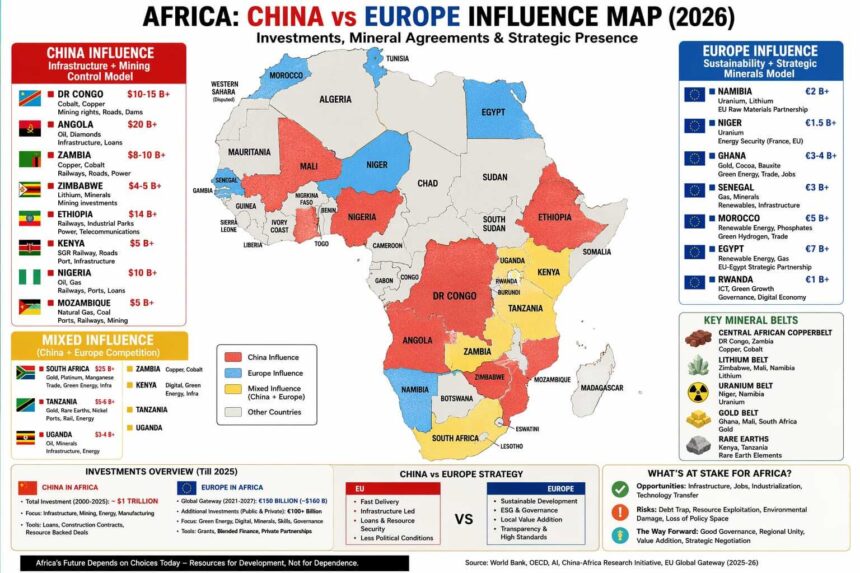
Africa remains the primary global hub for critical minerals. The Democratic Republic of the Congo holds vast reserves of cobalt, Zambia is rich in copper, Zimbabwe and Mali possess significant lithium deposits, while Namibia and Niger are key sources of uranium. South Africa is endowed with platinum and manganese, and countries like Tanzania and Madagascar have substantial rare earth deposits. This vast mineral wealth has attracted major global powers. China, in particular, has established a commanding lead over the past two decades. It controls nearly 85–90% of global rare earth processing capacity and dominates not only mining but also refining and supply chains.

China’s approach in Africa has largely followed the “infrastructure for resources” model, under which it builds roads, railways, and ports in exchange for long-term access to mineral resources. Through this strategy, it has secured strong positions in cobalt mining in the Congo, lithium projects in Zimbabwe, and oil and infrastructure sectors in countries such as Angola and Nigeria. By simultaneously investing in large-scale refining industries within China, it has consolidated control over global supply chains.
Europe, recognizing the strategic risks of overdependence on China, has accelerated its own engagement with Africa over the past five years. Through its €150 billion “Global Gateway” initiative, it is investing in infrastructure, green energy, and digital connectivity across the continent. Projects such as green hydrogen initiatives in Namibia, energy partnerships in Morocco, and the Lobito Corridor in Zambia reflect Europe’s growing strategic footprint. Importantly, Europe is also beginning to establish small-scale mineral processing units in Africa, moving beyond mere raw material imports toward value-added production.
India, by contrast, has made only limited progress. While it would be inaccurate to say that India has done nothing, its efforts remain fragmented and insufficient in comparison to global competitors. Some key institutions have begun to take initial steps. Khanij Bidesh India Limited (KABIL-Mineral Videshi India Ltd), a joint venture of public sector enterprises, is exploring overseas mining opportunities for lithium, cobalt, and other critical minerals. Its acquisition of a lithium block in Argentina marks a significant, though modest, beginning.

Similarly, National Mineral Development Corporation (NMDC Limited) is exploring international mining prospects, while Coal India Limited is considering diversification into critical minerals. In the private sector, Vedanta Resources is already engaged in copper mining operations in Zambia. The Tata Group and other industrial players are also looking to invest in battery supply chains. However, these efforts are still at an early stage and lack the scale, coordination, and strategic depth seen in China’s approach.
One of India’s biggest weaknesses lies in its lack of processing capacity. Mining alone does not ensure resource security; refining and value addition are equally, if not more, important. India continues to import processed minerals from countries like China and the United States, increasing costs and exposing its industries to supply chain disruptions. Even if India begins to invest aggressively now, it may take 10–15 years to build a fully integrated supply chain ecosystem.
The challenges ahead are significant. First, India must recognize mineral security as a matter of national security. Second, it needs to forge long-term agreements with African nations for stable resource access. Third, domestic refining and processing industries must be developed on a war footing. Fourth, substantial investments are required in technology, research, and skilled manpower. Finally, recycling systems must be strengthened to recover critical minerals from used products, reducing dependence on imports.
The economic implications are equally profound. Heavy reliance on mineral imports places pressure on foreign exchange reserves and exposes industries to global price volatility. Supply disruptions can directly impact manufacturing output, employment, and overall economic growth. Over time, this could undermine India’s economic stability and strategic autonomy.
Yet, this challenge also presents an opportunity. As the world transitions toward green energy and digital technologies, demand for critical minerals is set to surge. With the right strategy, India can position itself as a key player in global supply chains. By building equitable partnerships with African nations and investing across mining, processing, and manufacturing, it can secure both resources and technological leadership.
Ultimately, this is not merely a competition over minerals—it is a contest over the future of global economic power. Countries that control critical minerals will shape the trajectory of technological advancement. If India acts decisively now, it can secure its place in this emerging order. If not, its ambitions for technological self-reliance may remain constrained by dependence on external suppliers.

—————