

Where Is Internal Democracy in the Congress?
— Ch. V. Prabhakar Rao, Senior Journalist, 9391533339
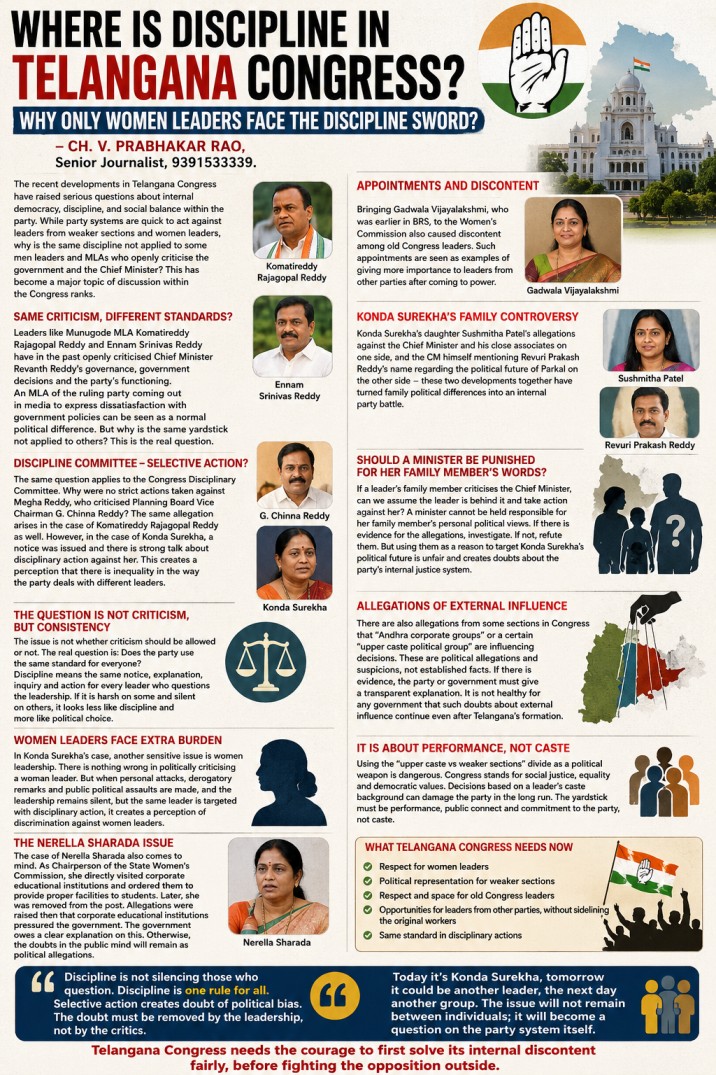
The recent developments within the Telangana Congress have raised serious questions about the party’s internal democracy, discipline and social balance. In particular, there are allegations that the party machinery is responding more quickly and firmly to leaders from weaker sections and women leaders, while questions are being raised as to why the same standards of discipline are seemingly not being applied to some male MLAs and leaders who have made strong public remarks about the functioning of the government.
Munugode MLA Komatireddy Rajagopal Reddy and Ennam Srinivas Reddy, for instance, have in the past publicly criticised Chief Minister Revanth Reddy’s administration, government decisions and the functioning of the party. An MLA from a ruling party publicly expressing dissatisfaction with government policies can certainly be viewed as a normal political difference of opinion. But the real question is: Why are the same standards not being applied to other leaders?
The same question applies to the Congress Disciplinary Committee. A section within the Congress is questioning why strict action was not taken against Megha Reddy for criticising Planning Commission Vice Chairman G. Chinna Reddy. There has also been criticism that the party’s disciplinary machinery did not respond with the same degree of seriousness to Komatireddy Rajagopal Reddy’s public statements. However, in the case of Konda Surekha, a notice was issued and there has been intense speculation about disciplinary action against her. This has strengthened the perception that the party is following different standards in dealing with different leaders.
The fundamental question here is not whether criticism should be allowed. The real question is whether the party uses the same yardstick for criticism. If every person who questions the party leadership is subjected to the same process of notice, explanation, inquiry and action, that can be called discipline. But if one person faces strict action while another is met with silence, there is a danger that discipline may appear more like political choice than organisational principle.

The Konda Surekha issue also raises another sensitive question concerning women’s leadership. There is nothing wrong with politically criticising a woman minister or senior woman leader. However, if personal allegations, insulting remarks and public political attacks are made against a woman leader, while the party leadership remains silent, but disciplinary action is subsequently contemplated against that same leader, it naturally creates an impression of discrimination against women leaders.
The Nerella Sharada episode also comes to mind in this context. During her tenure as Chairperson of the Women’s Commission, she directly responded to problems faced by students in corporate educational institutions. She visited certain colleges and directed them to provide proper facilities to students. She was subsequently removed from the post, and allegations were made at the time that pressure from corporate educational institutions was behind the decision. The government needs to provide a clear explanation regarding those allegations. Otherwise, the doubts that have emerged among the public will continue to remain merely political allegations.
The appointment of Gadwal Vijayalakshmi, who was earlier associated with the BRS, to the Women’s Commission also caused dissatisfaction among some old Congress leaders. Such appointments are being cited as examples of the allegation that, after coming to power, greater importance is being given to leaders who have joined the Congress from other parties.

Critics argue that this dissatisfaction has become even more visible in the Konda Surekha episode. On one side are the allegations made by her daughter Susmitha Patel against the Chief Minister and his close associates. On the other is the Chief Minister himself mentioning Revuri Prakash Reddy in connection with the political future of Parkal. Against the backdrop of these two developments, analysts believe that family-level political differences have evolved into an internal party conflict.
However, another important question arises here. If a family member of a political leader criticises the Chief Minister, how fair is it to assume that the leader herself is behind those statements and take action against a sitting minister? A minister cannot necessarily be held responsible for the personal political opinions of a family member.
If there is evidence to support the allegations made by Susmitha Patel, they should be investigated. If there is no evidence, they should be rejected. But using those allegations as a reason to question Konda Surekha’s political future creates doubts about the fairness of the party’s internal justice system.
There are also allegations from some sections within the Congress that “Andhra corporate groups” or a particular “upper-caste political group” are influencing these developments. However, rather than presenting such allegations as established facts, it must be clearly understood that these are political allegations and suspicions being voiced within the Congress. If there is evidence to support them, the party or government should provide a transparent explanation.
It is not healthy for any government if doubts continue to persist among the public about external political or economic influence even after the formation of Telangana.
At the same time, using an “upper caste versus weaker sections” division as a political weapon is equally dangerous. The history of the Congress is closely associated with social justice, equality and democratic values. Therefore, if an impression develops that the party leadership is making decisions based on the social background of individuals, it could cause long-term damage to the party.

The criterion should not be a leader’s caste. Political performance, public connect and commitment to the party should be the standards.
The criticism that leaders such as G. Chinna Reddy, who have carried the Congress flag for decades, are being sidelined while political opportunities are increasingly being given to leaders who have come from other parties also needs to be viewed in this context.
The argument that Chinna Reddy played a role in the Telangana statehood movement by securing a resolution with 41 MLAs in 2003 and submitting a memorandum to Sonia Gandhi has become a symbol of dissatisfaction among sections of the old Congress ranks over the political recognition being given to long-time party leaders.
The developments involving senior leader Thatiparthi Jeevan Reddy have also exposed the dissatisfaction among sections of the old Congress leadership. Once a party comes to power, the need to take along the leaders who helped build its organisational foundation becomes even more important.
Party workers are not needed only during elections. Their trust is also essential for sustaining the party and its government.
It is easy to dismiss dissatisfaction with Revanth Reddy’s leadership as merely “coterie politics.” But the Congress leadership must answer some fundamental questions: Are there genuine grounds behind these allegations? Is party discipline being applied equally to everyone? Are women leaders and leaders from weaker sections being given equal political space? Are the same standards being applied to leaders who have come from other parties and to old Congress leaders?
The Congress leadership must answer these questions.
Discipline does not mean silencing those who question the leadership. Discipline means one rule for everyone.
If no action is taken against an MLA who criticises the Chief Minister, while a woman minister in the same government faces notices and talk of expulsion, it is natural for doubts about political bias to arise. The responsibility for removing that doubt lies not with the critics, but with the party leadership itself.
The Telangana Congress currently needs, above all, not to search for internal enemies but to restore internal trust.
Respecting women leaders, ensuring adequate political representation for weaker sections, not ignoring old Congress leaders, providing opportunities to leaders who have joined from other parties without sidelining the party’s original workers, and, most importantly, following the same yardstick in disciplinary proceedings—these are crucial for the future of the Congress.
Otherwise, what begins today with Konda Surekha may tomorrow involve another leader and the day after another section of the party. At that point, the issue will no longer remain a dispute between individuals; it will become a question about the party’s institutional credibility itself.
What the Telangana Congress needs now, before fighting its political opponents, is the courage to provide a fair and just solution to its own internal dissatisfaction.